For folks who are seeking wildlife rehab, here's a directory link that also has some useful tips.
For an eloquent write-up on the scientific value of dead birds, "So You Found a Dead Bird" says things a bit better than I generally do. I would say that in some cases, there is such a thing as too common (but probably not for under-studied counties), and there is such a thing as "too far gone" for roadkill/decay/etc - but that also depends on the bird. Snow Bunting roadkill in TX? Only a wing or leg still 3D? Bring it in!
Showing posts with label research. Show all posts
Showing posts with label research. Show all posts
14 February 2012

05 November 2011
The "why" of window monitoring
Birds hit windows. It's pretty much impossible to overstate the extent of the issue. Pretty much everyone knows that it happens but very few people look beyond face value of the smudge on glass.
This is more eloquent than anything I've seen yet, so please take a look at
Tim O'Connell's piece: A window into the perils of migration. He beautifully outlines the "how" and "why" of dead birds as educational tools, as well as one example of the mind boggling architecture that causes such high mortality rates. Flat-sided buildings are bad enough, but a horseshoe with a 'corridor effect' cluster at one end? Yikes!
On a coincidental note, I'm about half way into a paper on the complexities of North American window collisions - they've been my constant companion since 2003 and I need to get my thoughts out of my head and into writing. Unfortunately it's a rather dry, sciency sort of writing, but I think the discussion will be helpful. It's just terribly difficult to keep citations sorted out since there are about 20 papers that cite each other ad infinitum and the resulting citation loop is frustrating. One paper that I criticize lists my paper in its citations, too, for that matter!
Anyway, here are some lovelies - Tennessee Warblers - from Principia, circa 2004-2005 (a tiny fraction of the actual species diversity and even fewer of the overall body count.)

External link: dead bird album
This is also cross-posted over at Big Bend Birds & Nature.
This is more eloquent than anything I've seen yet, so please take a look at
Tim O'Connell's piece: A window into the perils of migration. He beautifully outlines the "how" and "why" of dead birds as educational tools, as well as one example of the mind boggling architecture that causes such high mortality rates. Flat-sided buildings are bad enough, but a horseshoe with a 'corridor effect' cluster at one end? Yikes!
On a coincidental note, I'm about half way into a paper on the complexities of North American window collisions - they've been my constant companion since 2003 and I need to get my thoughts out of my head and into writing. Unfortunately it's a rather dry, sciency sort of writing, but I think the discussion will be helpful. It's just terribly difficult to keep citations sorted out since there are about 20 papers that cite each other ad infinitum and the resulting citation loop is frustrating. One paper that I criticize lists my paper in its citations, too, for that matter!
Anyway, here are some lovelies - Tennessee Warblers - from Principia, circa 2004-2005 (a tiny fraction of the actual species diversity and even fewer of the overall body count.)
External link: dead bird album
This is also cross-posted over at Big Bend Birds & Nature.
16 July 2011
near and dear to my hawk tower
I wondered if this day might come: the Smith Point Hawk Watch is basically losing funding for a season. It is a brilliant place to see raptor migration but counting hawks there is like trying to count spaghetti as they boil! Falcons and kites are a MUCH more reliable count, but the location is prime for kettling Wood Storks and Magnificent Frigatebirds at the same time.
It is where I 'cut my teeth' with raptors in high school, spent the better part of a fall after Prin and have followed every snippet of its life through hurricanes and budget ails. For birds, for bugs, for life, Smith Point is not to be ignored.
***
Subject: Smith Point Hawk Watch
From: Susan Heath sheath/GCBO.ORG
Date: Fri, 15 Jul 2011 15:07:08 -0500
TexBirders,
We have been warned by our leaders that belt-tightening must take place and that all will feel a little of the squeeze. That reality has hit GCBO's Research Program for the coming year. To be honest it has always been a touch-and-go situation when it comes to raising the resources necessary to fund the important Smith Point Hawk Watch, and some years GCBO has had to swallow much of the cost, draining funds away from other, equally important programs. The season, our 15th, we have had to make a lemons-to-lemonade situation on the raptor migration monitoring project. In the past, the cost of the hawk watch was shared between Hawk Watch International and GCBO. This year neither party was able to raise the necessary funds to cover the expenses associated with running the hawk watch. Therefore we have decided to do two things: (1) try to keep the count going with volunteers, and (2) change the focus of the count a bit. We have decided to focus on the Swallow-tailed Kite, since Smith Point is strategically located to sample much of the southward migration of this vulnerable iconic symbol of the southern bottomlands. Kites migrate earlier than other raptors so we will begin the season on August 1st instead of the 15th as in the past. The Swallow-tailed Kite migration is largely over by October 1st so we will concentrate on that 60-day period initially. Several intrepid volunteers from past seasons have already volunteered to cover much of that period, but we need a few more volunteers to fill out the calendar. Several volunteers have agreed to continue counting through November 15, to keep this season's data comparable to previous years. Last, but to some by no means least, if in past Smith Point seasons you were in the habit of swinging by the tower to use the sanitary facilities, don't bother. Sadly that has been a casualty of belt-tightening this season also. We are checking with local officials to see if any one else can support that need.
If you have hawk watch experience and would like to volunteer, please check the calendar at:
http://tinyurl.com/6ehoh3o
If you are available for any of the open dates, please e-mail Sue at sheath AT gcbo.org and let her know of your preference. We really appreciate the efforts of all our volunteers to help keep the Smith Point Hawk Watch alive. We have high hopes that we will be able to raise funding to resume with paid counters next year. To that end, if you would like to make a contribution to the hawk watch or know of other organizations that can, we would really appreciate the support. You can make a donation at:
https://www.justgive.org/nonprofits/donate.jsp?ein=76-0553113
and specify Smith Point Hawk Watch or mail a check to the address below. Thanks for your support everyone!
Sue Heath & John Arvin
Susan A. Heath, Ph.D.
Avian Conservation Biologist
Gulf Coast Bird Observatory
103 W. Hwy 332
Lake Jackson, TX 77566
979-480-0999
Join us in our quest to study and conserve birds and their habitat around the Gulf of Mexico.
www.gcbo.org
Sign-Up for our monthly E-News Letter
http://www.gcbo.org/default.aspx/MenuItemID/205/MenuGroup/Home.htm
It is where I 'cut my teeth' with raptors in high school, spent the better part of a fall after Prin and have followed every snippet of its life through hurricanes and budget ails. For birds, for bugs, for life, Smith Point is not to be ignored.
***
Subject: Smith Point Hawk Watch
From: Susan Heath sheath/GCBO.ORG
Date: Fri, 15 Jul 2011 15:07:08 -0500
TexBirders,
We have been warned by our leaders that belt-tightening must take place and that all will feel a little of the squeeze. That reality has hit GCBO's Research Program for the coming year. To be honest it has always been a touch-and-go situation when it comes to raising the resources necessary to fund the important Smith Point Hawk Watch, and some years GCBO has had to swallow much of the cost, draining funds away from other, equally important programs. The season, our 15th, we have had to make a lemons-to-lemonade situation on the raptor migration monitoring project. In the past, the cost of the hawk watch was shared between Hawk Watch International and GCBO. This year neither party was able to raise the necessary funds to cover the expenses associated with running the hawk watch. Therefore we have decided to do two things: (1) try to keep the count going with volunteers, and (2) change the focus of the count a bit. We have decided to focus on the Swallow-tailed Kite, since Smith Point is strategically located to sample much of the southward migration of this vulnerable iconic symbol of the southern bottomlands. Kites migrate earlier than other raptors so we will begin the season on August 1st instead of the 15th as in the past. The Swallow-tailed Kite migration is largely over by October 1st so we will concentrate on that 60-day period initially. Several intrepid volunteers from past seasons have already volunteered to cover much of that period, but we need a few more volunteers to fill out the calendar. Several volunteers have agreed to continue counting through November 15, to keep this season's data comparable to previous years. Last, but to some by no means least, if in past Smith Point seasons you were in the habit of swinging by the tower to use the sanitary facilities, don't bother. Sadly that has been a casualty of belt-tightening this season also. We are checking with local officials to see if any one else can support that need.
If you have hawk watch experience and would like to volunteer, please check the calendar at:
http://tinyurl.com/6ehoh3o
If you are available for any of the open dates, please e-mail Sue at sheath AT gcbo.org and let her know of your preference. We really appreciate the efforts of all our volunteers to help keep the Smith Point Hawk Watch alive. We have high hopes that we will be able to raise funding to resume with paid counters next year. To that end, if you would like to make a contribution to the hawk watch or know of other organizations that can, we would really appreciate the support. You can make a donation at:
https://www.justgive.org/nonprofits/donate.jsp?ein=76-0553113
and specify Smith Point Hawk Watch or mail a check to the address below. Thanks for your support everyone!
Sue Heath & John Arvin
Susan A. Heath, Ph.D.
Avian Conservation Biologist
Gulf Coast Bird Observatory
103 W. Hwy 332
Lake Jackson, TX 77566
979-480-0999
Join us in our quest to study and conserve birds and their habitat around the Gulf of Mexico.
www.gcbo.org
Sign-Up for our monthly E-News Letter
http://www.gcbo.org/default.aspx/MenuItemID/205/MenuGroup/Home.htm
30 December 2010
Resist Temptation
Gentle reminder, dear birders.
National Parks are no 'pishing' zones.
They are also no 'playback' zones.
This applies to State Parks, National Wildlife Refuges, Wildlife Management Areas, areas that are birded, ANY area that has endangered species, and at any time of year that birds could be nesting. It's in the better interest of the bird to avoid undue stress, activity, etc.
While iThings and eGadgets and crazyphones might be required for surviving the urban jungle, avoid temptation. Leave the devices off, or in your car while out birding. Use headphones if you want to double check a call you've heard. Don't know what you saw? Wait, look harder, or walk away. Don't know what you heard? Look for the source; not all recordings will cover all vocalizations.
***
This topic came up due to recent discussions at a CBC, and it highlights the technology gap that many birders have never experienced. Birders who have never birded without the technological crutch would have a very different experience without it. I have never used playback; Matt and I never even carry equipment capable of it. We go through a mental checklist of whether or not it's worth it for the bird and situation before 'pishing' - birds may go unseen, but it's better for the bird. The welfare of the creature is of utmost importance, our sighting/documentation is not even on the radar. For CBCs, in some situations, it may be worth it 'for the count' to get a better look at a bird. Still, all of the above checks and balances apply.
Learn calls. Leave the gear at home.
Our backgrounds are in conservation; perhaps this makes us more aware, but perhaps it also shows that bird-ing does not give birds the respect that is due.
National Parks are no 'pishing' zones.
They are also no 'playback' zones.
This applies to State Parks, National Wildlife Refuges, Wildlife Management Areas, areas that are birded, ANY area that has endangered species, and at any time of year that birds could be nesting. It's in the better interest of the bird to avoid undue stress, activity, etc.
While iThings and eGadgets and crazyphones might be required for surviving the urban jungle, avoid temptation. Leave the devices off, or in your car while out birding. Use headphones if you want to double check a call you've heard. Don't know what you saw? Wait, look harder, or walk away. Don't know what you heard? Look for the source; not all recordings will cover all vocalizations.
***
This topic came up due to recent discussions at a CBC, and it highlights the technology gap that many birders have never experienced. Birders who have never birded without the technological crutch would have a very different experience without it. I have never used playback; Matt and I never even carry equipment capable of it. We go through a mental checklist of whether or not it's worth it for the bird and situation before 'pishing' - birds may go unseen, but it's better for the bird. The welfare of the creature is of utmost importance, our sighting/documentation is not even on the radar. For CBCs, in some situations, it may be worth it 'for the count' to get a better look at a bird. Still, all of the above checks and balances apply.
Learn calls. Leave the gear at home.
Our backgrounds are in conservation; perhaps this makes us more aware, but perhaps it also shows that bird-ing does not give birds the respect that is due.
13 December 2010
Schrödinger's Quail
This morning at about 9:30 I got a phone call from a dear friend and fellow birder. He reported a deceased Montezuma Quail at the Lawrence E. Wood picnic area in the Davis Mountains. I was *thrilled* because I thought that meant that he had picked it up for me. Alas. He was already in Balmorhea and the bird was still on the side of the road!
In a hasty scramble, Matt and I attempted to notify birders in Alpine and Fort Davis and anyone who might possibly still be in the area after chasing the Tufted Flycatcher - and we came up empty handed. We knew that the bird was dead. But was it still there? Had it been hit again? What state was it in; smashed or still fresh? We summoned the powers of Sul Ross and The Nature Conservancy in the form of voice mail, e-mail and feeble telepathy. By 11:30 I was able to sneak away from work; we'd not been able to check e-mail since our initial plea, but it was worth the risk to discover whether or not 'Schrödinger's Quail' was still on the side of the road for me.
Best case scenario:
Dead Montezuma Quail would be in the shade on the side of the road.
Plausible Situation A:
Dead Montezuma Quail would be picked up by someone else.
Plausible Situation B:
Dead, smashed Montezuma Quail would be on the side of the road.
Plausible Situation C:
Dead Montezuma Quail would be unable to be located.
Clearly with A & C, there's room for interpretation. A phone or e-mail not to be received for a long time, a scavenger traipsing off with a prize...
So for the longest 90 minute drive, the Montezuma Quail was in a simultaneous state of being there and not-being-there; I just needed to open the proverbial box and look.
1: It is there!

2: The facial pattern indicates that the bird is male.

3: The poofy crown concealed a few pin feathers.

4: Disney's version of "Sleeping Beauty" got nothin' on this guy.

5: Big, scratchy, kicky claws. All the better to dig at roots with.

6: I spy something molting. The gap in primary feathers has a new one growing in.

Post to be elaborated upon once we've walked the dog and had dinner and... you get the idea =)
FAQ #1
Q: Aren't you worried about catching something?
A: No. As with windows and wind turbines, cars tend to hit birds that are healthy enough to cross roads. If the bird was a carrier of [West Nile, Avian Influenza, etc] I'd still probably have to lick it (for fecal/saliva contamination) and that's just not how I operate.
Edit: the slightly more stuffy version of this post is over at that other blog that steals all of our attention these days.
In a hasty scramble, Matt and I attempted to notify birders in Alpine and Fort Davis and anyone who might possibly still be in the area after chasing the Tufted Flycatcher - and we came up empty handed. We knew that the bird was dead. But was it still there? Had it been hit again? What state was it in; smashed or still fresh? We summoned the powers of Sul Ross and The Nature Conservancy in the form of voice mail, e-mail and feeble telepathy. By 11:30 I was able to sneak away from work; we'd not been able to check e-mail since our initial plea, but it was worth the risk to discover whether or not 'Schrödinger's Quail' was still on the side of the road for me.
Best case scenario:
Dead Montezuma Quail would be in the shade on the side of the road.
Plausible Situation A:
Dead Montezuma Quail would be picked up by someone else.
Plausible Situation B:
Dead, smashed Montezuma Quail would be on the side of the road.
Plausible Situation C:
Dead Montezuma Quail would be unable to be located.
Clearly with A & C, there's room for interpretation. A phone or e-mail not to be received for a long time, a scavenger traipsing off with a prize...
So for the longest 90 minute drive, the Montezuma Quail was in a simultaneous state of being there and not-being-there; I just needed to open the proverbial box and look.
1: It is there!

2: The facial pattern indicates that the bird is male.

3: The poofy crown concealed a few pin feathers.

4: Disney's version of "Sleeping Beauty" got nothin' on this guy.

5: Big, scratchy, kicky claws. All the better to dig at roots with.

6: I spy something molting. The gap in primary feathers has a new one growing in.

Post to be elaborated upon once we've walked the dog and had dinner and... you get the idea =)
FAQ #1
Q: Aren't you worried about catching something?
A: No. As with windows and wind turbines, cars tend to hit birds that are healthy enough to cross roads. If the bird was a carrier of [West Nile, Avian Influenza, etc] I'd still probably have to lick it (for fecal/saliva contamination) and that's just not how I operate.
Edit: the slightly more stuffy version of this post is over at that other blog that steals all of our attention these days.
04 December 2010
World Parrot Count - Jan. 1, 2011
I'm passing this along for friend and fellow parrots-out-of-native-range enthusiast, Roelant Jonker. He has been tracking feral parrots in The Netherlands for quite a few years now and this new project will help gauge populations of parrots out of their ranges. For folks in Texas, Louisiana, Florida, California, Illinois, New York, New Jersey and quite a few other states, this is a great opportunity to help out!
Our nearest Monk Parakeet colony is Andrews, TX where this photo was taken:

(by Laura Packer, Nov. 2007)
*****
Our nearest Monk Parakeet colony is Andrews, TX where this photo was taken:
(by Laura Packer, Nov. 2007)
*****
You are cordially invited to join the "World Parrot Count". We, Roelant Jonker and Michael Braun of the "extra-tropical department" of the Parrot Researchers Group of the International Ornithological Union (IOU), would like to initiate the first global parrot census this January in order to get much needed scientific data about parrots living in cities around the globe. This count is intended to become an annual event.
For furth...er information please visit the following website: http://www.cml.leiden.edu/parrot.html
If you have any questions please contact us via the following E-mail address: parrotcount/at/cityparrots.org
Please feel free to forward this message to everybody who could be interested. We would like to create a global parrot community of professional researchers, field ornithologists as well as amateur naturalist that will enable us to measure the development of native and non-native parrots living in cities.
See you at the roost!
All best,
Roelant Jonker (Leiden University, The Netherlands)
Michael Braun (Heidelberg University, Germany)
14 November 2010
Trans-Pecos Christmas Bird Counts
[crossposted and backdated from our Big Bend regional blog]
The 'Christmas Bird Count' or CBC is a long tradition (see wiki link here) among birders. Perks? It encourages birding during an under-birded time of year as well as covering areas that aren't always included in casual birding. It's essentially a citizen-based bird census that takes place all over the continent between December 14th and January 5th.
Why not celebrate the New Year in a gorgeous part of the state while contributing to science? CBCs are great for people with all levels of bird interest - there's ample opportunity to learn and just because you can't identify them doesn't mean you can't spot them! Also, note-takers are in high demand (without notes, what data have you got?)
For more CBCs check out Houston Audubon's list of Texas Christmas Bird Counts for 2010-2011
In the Big Bend region, we've got a few to CBCs consider:
Sat. Dec. 18 - Davis Mountains
Sun. Dec. 19 - Balmorhea
Contact for both: Marty Hansen, birdsinflight/at/mac.com
Tues. Dec. 28 - Chisos Basin (Big Bend National Park)
Meet at 7:30 am in the visitor center, reconvene in the evening at the Panther Junction auditorium (around 6:00 PM) to compile the day's counts , pay registration fees, and prepare for the next day count.
Weds. Dec. 29 - Rio Grande Village (Big Bend National Park)
Meet at 7:30 am at the Rio Grande Village store. Meet again at Panther Junction auditorium to compile the list in the evening.
Contact for both BBNP counts: Mark Flippo, Mark_R_Flippo/at/nps.gov
Sat. Jan. 1 - Guadalupe Mountains
It is worth noting the dire situation for the Guadalupe Mountains CBC:
Note on dates:
Counts used to start on the "second Saturday in December" and then it was changed to Dec. 14 regardless of day, causing a lot of conflict in areas that have many counts but not enough birders to go around! So when living on the Upper Texas Coast, I could do nearly 20 counts in one season because of ample weekend counts - when the dates changed and counts started to overlap, I was only able to do maybe eight. With only five counts out here, I sure hope there's good attendance!
The 'Christmas Bird Count' or CBC is a long tradition (see wiki link here) among birders. Perks? It encourages birding during an under-birded time of year as well as covering areas that aren't always included in casual birding. It's essentially a citizen-based bird census that takes place all over the continent between December 14th and January 5th.
Why not celebrate the New Year in a gorgeous part of the state while contributing to science? CBCs are great for people with all levels of bird interest - there's ample opportunity to learn and just because you can't identify them doesn't mean you can't spot them! Also, note-takers are in high demand (without notes, what data have you got?)
For more CBCs check out Houston Audubon's list of Texas Christmas Bird Counts for 2010-2011
In the Big Bend region, we've got a few to CBCs consider:
Sat. Dec. 18 - Davis Mountains
Sun. Dec. 19 - Balmorhea
Contact for both: Marty Hansen, birdsinflight/at/mac.com
Tues. Dec. 28 - Chisos Basin (Big Bend National Park)
Meet at 7:30 am in the visitor center, reconvene in the evening at the Panther Junction auditorium (around 6:00 PM) to compile the day's counts , pay registration fees, and prepare for the next day count.
Weds. Dec. 29 - Rio Grande Village (Big Bend National Park)
Meet at 7:30 am at the Rio Grande Village store. Meet again at Panther Junction auditorium to compile the list in the evening.
Contact for both BBNP counts: Mark Flippo, Mark_R_Flippo/at/nps.gov
Sat. Jan. 1 - Guadalupe Mountains
It is worth noting the dire situation for the Guadalupe Mountains CBC:
Contact: Fred Armstrong, Fred_Armstrong@nps.gov
We have tried to set our count as the last Saturday of the count period every year so that people can routinely make plans. We would welcome the help. Several of our routine participants have died, moved away, aged to the point of not being able to do the hiking, etc., so I have been crying for help over the past couple of years. In the winter some of the park apartments or RV pads are vacant and I can usually offer a place to stay for $8 a person a night so participants can be here at dawn. Stay in touch and let me know if you or others can join us so I can pre-assign coverage areas. Thanks.
Note on dates:
Counts used to start on the "second Saturday in December" and then it was changed to Dec. 14 regardless of day, causing a lot of conflict in areas that have many counts but not enough birders to go around! So when living on the Upper Texas Coast, I could do nearly 20 counts in one season because of ample weekend counts - when the dates changed and counts started to overlap, I was only able to do maybe eight. With only five counts out here, I sure hope there's good attendance!
11 September 2010
falcon finale
Things have been busy lately between cleaning two houses and packing! So for the silence, we offer our apologies. It is at least with good news that we wrap up our ~2 months with Aplomado Falcons.
10 September - 93 showed up for dinner carrying his own small, unidentified snack.
8 September - 16, 95, H7, 93... two birds from Group I, two from Group III. 95 had been gone since 1 September, so it was a surprise to see him again.
Here are the final numbers for our groups - since most birds were at or just under 40 days when released, you can base "Age Last Seen" on that. Good news: pretty much anything over 61 days, in this case, counts as successful.
Group I - Released 10 July
Name / Sex Date Last Seen Age Last Seen
Green K8 / F 17 August 77 days
Red OK / M 28 August 89 days
Green 16 / M 8 September 99 days
Red 59 / M 11 July 40 days
Green 95 / M 8 September 98 days
Red 78 / M 11 July 40 days
Green 58 / M 30 August 90 days
Group II - Released 11 July
Name / Sex Date Last Seen Age When Last Seen
Red OP / M 11 July 40 days
Green K6 / F 24 July 56 days
Red C2 / F 13 August 71 days
Green 66 / M 15 July 42 days
Red 43 / M 15 July 42 days
Green 83 / M 4 August 62 days
Red 13 / M 11 July 38 days
Group III - Released 31 July
Name / Sex Date Last Seen Age When Last Seen
Red 93 / M 10 September 81 days
Green H7 / F 8 September 78 days
Green 32 / M 1 August 40 days
Red 24 / M 1 August 40 days
Green 15 / M 1 August 38 days
10 September - 93 showed up for dinner carrying his own small, unidentified snack.
8 September - 16, 95, H7, 93... two birds from Group I, two from Group III. 95 had been gone since 1 September, so it was a surprise to see him again.
Here are the final numbers for our groups - since most birds were at or just under 40 days when released, you can base "Age Last Seen" on that. Good news: pretty much anything over 61 days, in this case, counts as successful.
Group I - Released 10 July
Name / Sex Date Last Seen Age Last Seen
Green K8 / F 17 August 77 days
Red OK / M 28 August 89 days
Green 16 / M 8 September 99 days
Red 59 / M 11 July 40 days
Green 95 / M 8 September 98 days
Red 78 / M 11 July 40 days
Green 58 / M 30 August 90 days
Group II - Released 11 July
Name / Sex Date Last Seen Age When Last Seen
Red OP / M 11 July 40 days
Green K6 / F 24 July 56 days
Red C2 / F 13 August 71 days
Green 66 / M 15 July 42 days
Red 43 / M 15 July 42 days
Green 83 / M 4 August 62 days
Red 13 / M 11 July 38 days
Group III - Released 31 July
Name / Sex Date Last Seen Age When Last Seen
Red 93 / M 10 September 81 days
Green H7 / F 8 September 78 days
Green 32 / M 1 August 40 days
Red 24 / M 1 August 40 days
Green 15 / M 1 August 38 days
23 July 2010
How You Can Help
TPWD's Aplomado Falcon Species Overview
(or copy/paste http://www.tpwd.state.tx.us/huntwild/wild/species/aplomfal )
The above link is a great way to get familiar with Aplomado Falcons as they currently exist in Texas.
Here is what they say about How You Can Help
(All added emphasis mine.)
...another help is a good headwind.
(or copy/paste http://www.tpwd.state.tx.us/huntwild/wild/species/aplomfal )
The above link is a great way to get familiar with Aplomado Falcons as they currently exist in Texas.
Here is what they say about How You Can Help
Aplomados can be sensitive to human disturbance, especially during the breeding season. Human activity, including close or prolonged intrusion in a bird's territory, or loud and unusual noises, can cause nest abandonment. Human intrusions can also make Aplomados more susceptible to detection and harm from potential predators. A safe viewing distance is 200 yards or more. Suitable viewing at this or greater distance may require a spotting scope with 10 to 15 X or greater magnification. Birders should always respect private property rights in Texas regardless of the species being pursued.
Birders should keep in mind that Aplomados remain extremely rare in Texas and are federally- and statelisted as endangered. Therefore, all reasonable and suspected sightings of this bird should be reported immediately to an expert birder, Texas Parks and Wildlife Department, or the U.S. Fish and Wildlife Service for further verification. Observations should include a detailed description of the bird's location, appearance, activity, and surroundings. Verification of sightings is extremely important in the context of the Aplomado's scarcity and future conservation.
Ultimately, recovery of Aplomados in Texas will depend on the interest and direct involvement of private land owners since lands within the falcon's former range are mostly in private ownership. Texas land holders interested in promoting Aplomado Falcon conservation measures should consult with experts in the Texas Parks and Wildlife Department, U.S. Fish and Wildlife Service, or The Peregrine Fund for technical guidance and other assistance. Texans can contribute to nongame wildlife resources conservation by supporting the Texas Parks and Wildlife Department's "Special Nongame and Endangered Species Conservation Fund" and by purchases of special nongame decals and stamps issued by the department. A set portion of the revenues generated by these programs is used to purchase endangered species habitats and to support the publication of nongamewildlife informational materials and other nongame activities.
(All added emphasis mine.)
...another help is a good headwind.
Aplomado Falcon Hack Site Attendant
Here's a quick FAQ list for folks new to the recent posts:
What are we?
For July, August and September, we are Aplomado Falcon Hack Site Attendants. Meaning we feed/water/babysit Aplomado Falcons at a "hack" site.
Hack = falconry term for "release"
A what falcon?
Aplomado Falcons are the only Endangered falcon species in North America; Peregrines were de-listed not too long ago. They are roughly the size of a long, slender pigeon, a bit bigger than the American Kestrel ("sparrowhawk"). While they are still found in northern Mexico, due to overgrazing and poor land management they were extirpated* from their former range in New Mexico as well as south and west Texas. Their habitat preference is open, dry grassland interspersed with yucca (a nest site favorite) and low shrubs. Their food preference is small birds.
* extirpated = they no longer occur in a region that they occupied in the past (you could say that bison were completely extirpated from their historical range - they are not extinct)
What is the job?
Aplomado Falcons are raised at The Peregrine Fund's World Center for Birds of Prey in Boise, Idaho. As they approach 40 days old, they are sent to release sites where they are kept in boxes on towers until such time as they can be released (around 40 days old). After release, there are morning and afternoon feedings and observations. We take notes on anything significant in terms of behavior and report back to our field supervisor who is the brains behind our site and others in the region. Constant feeding and monitoring is required to ensure that leftover quail parts won't attract raccoons, vultures, ravens, etc.
How many falcons will you release?
Our site is scheduled to have only one more box (5-7) after these first two (14 in the first batch). There is no way we'll still have 21 birds accounted for at the end of the project, sadly the odds are not in favor of that. Indeed, a few birds didn't even return after their release days.
Released on the 10th, last seen on the 11th:
59BR
78BR
Released on the 11th, last seen on the 11th:
OPBR
13BR
Released on the 11th, last seen on the 15th:
42BR
66BG
(All of the above birds are male; they have a black band over a color band on their left leg and one aluminum band on the right leg. So 59BR would be a 5 black over 9 red. Oddly, only one missing bird has a green lower band - this means that the vast majority of our remaining birds are black/green and only two are black/red!)
So as of the 19th, eight birds are "regulars" and seen every day, feed every day, and are otherwise accounted for. Only three birds remain from the release on the 11th, and two of them are females. All but two are still around from that first release, and the two who went missing, did so very early on. Owls are a huge predator threat at this stage so our fingers are crossed.
Helpful links for Aplomado Falcon information:
The Peregrine Fund - Aplomado Falcon Conservation Project
The Peregrine Fund - Aplomado Falcon General Information
Wiki - Aplomado Falcon
What are we?
For July, August and September, we are Aplomado Falcon Hack Site Attendants. Meaning we feed/water/babysit Aplomado Falcons at a "hack" site.
Hack = falconry term for "release"
A what falcon?
Aplomado Falcons are the only Endangered falcon species in North America; Peregrines were de-listed not too long ago. They are roughly the size of a long, slender pigeon, a bit bigger than the American Kestrel ("sparrowhawk"). While they are still found in northern Mexico, due to overgrazing and poor land management they were extirpated* from their former range in New Mexico as well as south and west Texas. Their habitat preference is open, dry grassland interspersed with yucca (a nest site favorite) and low shrubs. Their food preference is small birds.
* extirpated = they no longer occur in a region that they occupied in the past (you could say that bison were completely extirpated from their historical range - they are not extinct)
What is the job?
Aplomado Falcons are raised at The Peregrine Fund's World Center for Birds of Prey in Boise, Idaho. As they approach 40 days old, they are sent to release sites where they are kept in boxes on towers until such time as they can be released (around 40 days old). After release, there are morning and afternoon feedings and observations. We take notes on anything significant in terms of behavior and report back to our field supervisor who is the brains behind our site and others in the region. Constant feeding and monitoring is required to ensure that leftover quail parts won't attract raccoons, vultures, ravens, etc.
How many falcons will you release?
Our site is scheduled to have only one more box (5-7) after these first two (14 in the first batch). There is no way we'll still have 21 birds accounted for at the end of the project, sadly the odds are not in favor of that. Indeed, a few birds didn't even return after their release days.
Released on the 10th, last seen on the 11th:
59BR
78BR
Released on the 11th, last seen on the 11th:
OPBR
13BR
Released on the 11th, last seen on the 15th:
42BR
66BG
(All of the above birds are male; they have a black band over a color band on their left leg and one aluminum band on the right leg. So 59BR would be a 5 black over 9 red. Oddly, only one missing bird has a green lower band - this means that the vast majority of our remaining birds are black/green and only two are black/red!)
So as of the 19th, eight birds are "regulars" and seen every day, feed every day, and are otherwise accounted for. Only three birds remain from the release on the 11th, and two of them are females. All but two are still around from that first release, and the two who went missing, did so very early on. Owls are a huge predator threat at this stage so our fingers are crossed.
Helpful links for Aplomado Falcon information:
The Peregrine Fund - Aplomado Falcon Conservation Project
The Peregrine Fund - Aplomado Falcon General Information
Wiki - Aplomado Falcon
22 July 2010
cough it up
Cats have hairballs. Birds do, too. Owls are perhaps the best known family for their pellets - most folks have to dissect an owl pellet in school at some point. Frugivores (fruit eaters) don't consume so much indigestible stuff, so they don't have to cough up pellets. Long-billed Curlews, who eat crustaceans, do hack up pellets. Shrikes, hawks, even kookaburras - if they eat bone, fur, etc, as part of their diet and can't digest it, they have the ability to expel the undigested material.
Meet 58BG, who happened to fling a pellet while I was recording:
In case you missed the pellet being flung:


That gray clump? That's the pellet. Don't see it? Meet my horrible photoshop skills (bear with me, it's a new editing program I'm tampering with!)


The glob of feathers and bone being flung away looks pretty darn huge. So like any bodily-function enthusiast, after 58 left, I went over to investigate. Considering at least two pellets were expelled (one shortly before I started recording), that's an awful lot of Mystery-Quail-Parts to be coughed up. Not wanting to let a good photo chance go to waste, I now present this lovely image:

For those inquisitive minds, I did not handle it with bare hands, that's what sticks are for. Texture, however, was easy to note - slimy! Once it dried, the texture looked a bit more powdery, but that's less exciting to discuss. In a few days it will probably crumble away to nothing, but at least it has been documented in a fairly fresh state. Eeew.
Matt would like to point out that our birds are not dainty eaters. They do not carefully select which nibble of muscle upon which they will snack. They are given whole quail and if they don't fling the feathers away, down the throat! There isn't much waste, either. A very well-picked quail ends up having only wings, legs and maybe a keel... if that! Apparently heads are a delicacy, we'll find parts of the beak, but I suppose the skull is as lightweight as the rest of the other bones, so that's pretty easy to choke down along with other juicy morsels.
A quick note on other bodily functions:

What goes in comes out as an entirely different segment of the environment. After giving energy, it continues to nourish the ground and shelter small creatures. And it's very handy to roll, if you're an excrement enthusiast like dung beetles are. While 58's pellet may never sprout a mushroom or be bundled off with a flourish, it's far less obnoxious to accidentally step in!
Thanks for stopping in, sorry to have ruined your appetite!
Meet 58BG, who happened to fling a pellet while I was recording:
In case you missed the pellet being flung:
That gray clump? That's the pellet. Don't see it? Meet my horrible photoshop skills (bear with me, it's a new editing program I'm tampering with!)
The glob of feathers and bone being flung away looks pretty darn huge. So like any bodily-function enthusiast, after 58 left, I went over to investigate. Considering at least two pellets were expelled (one shortly before I started recording), that's an awful lot of Mystery-Quail-Parts to be coughed up. Not wanting to let a good photo chance go to waste, I now present this lovely image:
For those inquisitive minds, I did not handle it with bare hands, that's what sticks are for. Texture, however, was easy to note - slimy! Once it dried, the texture looked a bit more powdery, but that's less exciting to discuss. In a few days it will probably crumble away to nothing, but at least it has been documented in a fairly fresh state. Eeew.
Matt would like to point out that our birds are not dainty eaters. They do not carefully select which nibble of muscle upon which they will snack. They are given whole quail and if they don't fling the feathers away, down the throat! There isn't much waste, either. A very well-picked quail ends up having only wings, legs and maybe a keel... if that! Apparently heads are a delicacy, we'll find parts of the beak, but I suppose the skull is as lightweight as the rest of the other bones, so that's pretty easy to choke down along with other juicy morsels.
A quick note on other bodily functions:
What goes in comes out as an entirely different segment of the environment. After giving energy, it continues to nourish the ground and shelter small creatures. And it's very handy to roll, if you're an excrement enthusiast like dung beetles are. While 58's pellet may never sprout a mushroom or be bundled off with a flourish, it's far less obnoxious to accidentally step in!
Thanks for stopping in, sorry to have ruined your appetite!
17 July 2010
elegance
Here's a snippet of the agility, grace and elegance that our young Aplomado Falcons now exhibit:
They've only been out of the box since July 10 and 11, so this really isn't too bad!
They've only been out of the box since July 10 and 11, so this really isn't too bad!
14 July 2010
last of the box
We saw these birds from the transport box:

Into hand:

Into the box:

Peeking into the box:

And now this:
Growing so fast, no?
Into hand:
Into the box:
Peeking into the box:
And now this:
Growing so fast, no?
09 July 2010
a peek at k8
One bird in the first release group is K8 - you can see the bands on 59 and OK clearly in this snippet, but K8 is the restless alpha female you see at the end (actually, the only female in the group). Her constant pacing and impatient hopping around often leaves other birds wondering how they were knocked from their perch. She's feisty. This morning most of her tail feathers were a few inches shorter - in the final moments of the video below, you can see some of them starting to break.
It won't impact her much, since baby feathers are fairly weak to begin with. They just grow super quickly and it takes a lot of energy to get them out so fast. Adult feathers are slower to come in and of a much higher quality.
[will add two more photos here when I get a chance!]
EDIT:


In the lower photo, you can see the quail board in the background - we slide a little wooden tray into the box so the falcons never see us. Quail are zip-tied to the board so the birds won't pull them all off the board... it prevents buildup of nasty, over-ripe, smelly quail pieces. Aren't you glad you asked?
It won't impact her much, since baby feathers are fairly weak to begin with. They just grow super quickly and it takes a lot of energy to get them out so fast. Adult feathers are slower to come in and of a much higher quality.
[will add two more photos here when I get a chance!]
EDIT:
In the lower photo, you can see the quail board in the background - we slide a little wooden tray into the box so the falcons never see us. Quail are zip-tied to the board so the birds won't pull them all off the board... it prevents buildup of nasty, over-ripe, smelly quail pieces. Aren't you glad you asked?
06 July 2010
faces
Here are a few more snippets from yesterday's transfer -
These birds all hatched in the June 1-4 span, so they're almost ready to adventure out and figure out what this life is all about. You can tell from the videos that they really are Not Thrilled about this handling and going from box to box with [un]pleasantries exchanged...
Overall, this is a project that *does* something. Allow me to explain. For example, a baby ocelot or jaguar born in a zoo will stay in a zoo. It will live out its life in relatively crowded conditions (compared to wild ranges), it will be subjected to constant human contact, never be able to roam its own native habitat...
I've worked with Attwater's Prairie Chickens, nearly doomed to extinction by urban sprawl, fencing, overgrazing, and loss of prairie (and trees, among other things). They are essentially found in only 2 places - dedicated preserves where they are heavily repopulated, and captive breeding projects.
So to antagonize young falcons may be temporarily unpleasant for them, but they will live the life of a falcon. Their species still exists in the wild, their habitat still remains. They will not be shuffled off to other captive breeding programs because their survival in the wild is impossible. Yet these are the last of the Endangered falcons in North America - Peregrines were de-listed a while ago.

...ponder these faces and think about how it's easier to save habitat before something is Endangered, because once the habitat and ecology surrounding a critter are gone, you need all of that in place for reintroduction. If that is even possible. Otherwise, if captivity is the last chance for the species, is it really surviving at all? Or are we, as humans in general, simply setting aside a feeling of guilt with captive populations because the critters are not technically Extinct?

These birds all hatched in the June 1-4 span, so they're almost ready to adventure out and figure out what this life is all about. You can tell from the videos that they really are Not Thrilled about this handling and going from box to box with [un]pleasantries exchanged...
Overall, this is a project that *does* something. Allow me to explain. For example, a baby ocelot or jaguar born in a zoo will stay in a zoo. It will live out its life in relatively crowded conditions (compared to wild ranges), it will be subjected to constant human contact, never be able to roam its own native habitat...
I've worked with Attwater's Prairie Chickens, nearly doomed to extinction by urban sprawl, fencing, overgrazing, and loss of prairie (and trees, among other things). They are essentially found in only 2 places - dedicated preserves where they are heavily repopulated, and captive breeding projects.
So to antagonize young falcons may be temporarily unpleasant for them, but they will live the life of a falcon. Their species still exists in the wild, their habitat still remains. They will not be shuffled off to other captive breeding programs because their survival in the wild is impossible. Yet these are the last of the Endangered falcons in North America - Peregrines were de-listed a while ago.
...ponder these faces and think about how it's easier to save habitat before something is Endangered, because once the habitat and ecology surrounding a critter are gone, you need all of that in place for reintroduction. If that is even possible. Otherwise, if captivity is the last chance for the species, is it really surviving at all? Or are we, as humans in general, simply setting aside a feeling of guilt with captive populations because the critters are not technically Extinct?
05 July 2010
Boxes
The elegant cardboard transport container:
The fancy plywood home base:
...we have fourteen baby Aplomado Falcons!
The fancy plywood home base:
...we have fourteen baby Aplomado Falcons!
Pollinators between rain events
Alex-influenced rain followed Heidi and I all the way out here. I had lived out here for ~ 4 yrs and never had consistent rain, for so many consecutive days.
At the moment it is partly cloudy, and the wildlife is happy. Particularly at a shrub in the front yard. SO many wasp species, a few net-winged beetles, and some familiar butterflies.
One of my favorite members of the wasp order, Hymenoptera, is the Cicada Killer (Sphecius spp):

These are huge 2+ inches long insects. When one hears within the monotony of the "whining cicadas" summer-long buzz a cicada quickly and individually deviate its contribution, likely it's due to an attack from Sphecius species.
One particularly interesting wasp family is Scoliidae. They are largish, hairy insects that are parasitic to larvae of scarab beetles.

Females dig around to uncover scarab larvae, lay an egg on it, and peace on out of there.
So many other wasp species on that particular shrub, so little time.
A few butterflies found their way on to it, all of which are very familiar:
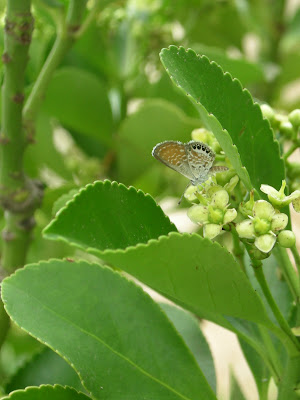
Western Pygmy-Blue (Brephidium exile), North America's smallest butterfly with a wingspan that may not even reach half an inch.

Reakirt's Blue (Echinargus isola)

Texan Crescent (Anthanassa texana)
We do have a porch light. As Heidi mentioned, there happens to be an active Barn Swallow (Hirundo rustica) nest using it as substrate. So we are going to have to come-up with another plan for attracting moths at least until that nest has fledged.
It is currently in incubation stage.
We've named the swallow Gladys. However, it has been observed that both parents share incubation duties.... how nice. So Gladys is female, and Gladys is male.
This is Gladys...., well, Sir Gladys I suppose:

Also, our first two groups of young Aplomado Falcons (Falco femoralis) arrive this afternoon!

We don't have internet at the house. We have to walk several blocks down slope to pirate wireless from a local business. With that in mind, plus once the falcons arrive we'll be going full-throttle, we aren't yet sure how regular our blog updates will become.
We will all just have to see.
At the moment it is partly cloudy, and the wildlife is happy. Particularly at a shrub in the front yard. SO many wasp species, a few net-winged beetles, and some familiar butterflies.
One of my favorite members of the wasp order, Hymenoptera, is the Cicada Killer (Sphecius spp):
These are huge 2+ inches long insects. When one hears within the monotony of the "whining cicadas" summer-long buzz a cicada quickly and individually deviate its contribution, likely it's due to an attack from Sphecius species.
One particularly interesting wasp family is Scoliidae. They are largish, hairy insects that are parasitic to larvae of scarab beetles.
Females dig around to uncover scarab larvae, lay an egg on it, and peace on out of there.
So many other wasp species on that particular shrub, so little time.
A few butterflies found their way on to it, all of which are very familiar:
Western Pygmy-Blue (Brephidium exile), North America's smallest butterfly with a wingspan that may not even reach half an inch.
Reakirt's Blue (Echinargus isola)
Texan Crescent (Anthanassa texana)
We do have a porch light. As Heidi mentioned, there happens to be an active Barn Swallow (Hirundo rustica) nest using it as substrate. So we are going to have to come-up with another plan for attracting moths at least until that nest has fledged.
It is currently in incubation stage.
We've named the swallow Gladys. However, it has been observed that both parents share incubation duties.... how nice. So Gladys is female, and Gladys is male.
This is Gladys...., well, Sir Gladys I suppose:
Also, our first two groups of young Aplomado Falcons (Falco femoralis) arrive this afternoon!
We don't have internet at the house. We have to walk several blocks down slope to pirate wireless from a local business. With that in mind, plus once the falcons arrive we'll be going full-throttle, we aren't yet sure how regular our blog updates will become.
We will all just have to see.
28 June 2010
Bird-Safe Buildings & bis spaeter
I've just added a fantastic link to our "the links we can link" section of the sidebar - Bird-Safe Buildings by Project BirdSafe of MN Audubon.
There's a pdf on the site that is absolutely fantastic and I'd love to see it incorporated in references for architecture, urban planning, landscape design, biology, etc. It is relevant to all of the above. Maybe even astronomy, due to the light pollution factors!
To download the pdf, click here. It's the best 3.7 MB you'll download this year.
As for the 'bis spaeter' portion of the title - on Friday, we are heading out towards Fort Stockton, where we'll be for the next three months. Here's a little snippet of what we'll be involved in - Aplomado Falcon Update via The Peregrine Fund. Hopefully we'll be able to update the blog on occasion, but if not, the abundance of posts this month will hopefully make up for it!
There's a pdf on the site that is absolutely fantastic and I'd love to see it incorporated in references for architecture, urban planning, landscape design, biology, etc. It is relevant to all of the above. Maybe even astronomy, due to the light pollution factors!
To download the pdf, click here. It's the best 3.7 MB you'll download this year.
As for the 'bis spaeter' portion of the title - on Friday, we are heading out towards Fort Stockton, where we'll be for the next three months. Here's a little snippet of what we'll be involved in - Aplomado Falcon Update via The Peregrine Fund. Hopefully we'll be able to update the blog on occasion, but if not, the abundance of posts this month will hopefully make up for it!
18 June 2010
Curlews
Curlews on the move is a post that is now up over at I Found a Banded Bird, feel free to check it out and admire the science behind tracking Long-Billed Curlews (Numenius americanus).
Inspired by the Nebraska Long-billed Curlew Tracking Project.
Inspired by the Nebraska Long-billed Curlew Tracking Project.
10 June 2010
Impacts of oil
Trying to keep things lighthearted has been a challenge lately, so I'll just provide a few links of good reading:
The American Birding Association "gulf" blog:
http://birding.typepad.com/gulf/
And a rebuttal to the "kill, don't clean oiled birds" argument:
http://scienceblogs.com/grrlscientist/2010/06/oiled_birds_to_kill_or_not_to.php
If you've got time, there are volunteer options through National Audubon:
http://www.audubon.org/campaign/advisory/advisory1006.html#volunteer
It looks like we'll be spending most of July and a few of the following months out in the Big Bend region, more details to come eventually.
The American Birding Association "gulf" blog:
http://birding.typepad.com/gulf/
And a rebuttal to the "kill, don't clean oiled birds" argument:
http://scienceblogs.com/grrlscientist/2010/06/oiled_birds_to_kill_or_not_to.php
If you've got time, there are volunteer options through National Audubon:
http://www.audubon.org/campaign/advisory/advisory1006.html#volunteer
It looks like we'll be spending most of July and a few of the following months out in the Big Bend region, more details to come eventually.
Subscribe to:
Posts (Atom)




 Posts
Posts


