Finally, the video you've all been waiting for (even if you didn't know it!) ...three Aplomado Falcons chasing a young Northern Harrier. This is from September 4th around 7 pm. The drama lasted for a few minutes and the harrier was escorted out of the Aplo territory. I suggest having your volume all the way up to hear the little fellows.
[someday, there will be a video here]
Shadowboxing mantis footage might take a while ;-)
A quick personal update:
Yes, we really are moving to Marathon officially. This update is from Waco, because the internet here is amazing. We'll be on the road this weekend (so be extra nice to folks with U-Haul trailers!) and then it's back to making the house livable. One more coat of paint in the living room and two on the trim should do the trick. The kitchen is another story entirely though!
Edit: I'll try to re-upload the video after the move if it didn't work. Apologies! [vid 9/4 706]
Edit: See? The video DOES exist!
Showing posts with label Aplomado Falcons. Show all posts
Showing posts with label Aplomado Falcons. Show all posts
24 September 2010

11 September 2010
falcon finale
Things have been busy lately between cleaning two houses and packing! So for the silence, we offer our apologies. It is at least with good news that we wrap up our ~2 months with Aplomado Falcons.
10 September - 93 showed up for dinner carrying his own small, unidentified snack.
8 September - 16, 95, H7, 93... two birds from Group I, two from Group III. 95 had been gone since 1 September, so it was a surprise to see him again.
Here are the final numbers for our groups - since most birds were at or just under 40 days when released, you can base "Age Last Seen" on that. Good news: pretty much anything over 61 days, in this case, counts as successful.
Group I - Released 10 July
Name / Sex Date Last Seen Age Last Seen
Green K8 / F 17 August 77 days
Red OK / M 28 August 89 days
Green 16 / M 8 September 99 days
Red 59 / M 11 July 40 days
Green 95 / M 8 September 98 days
Red 78 / M 11 July 40 days
Green 58 / M 30 August 90 days
Group II - Released 11 July
Name / Sex Date Last Seen Age When Last Seen
Red OP / M 11 July 40 days
Green K6 / F 24 July 56 days
Red C2 / F 13 August 71 days
Green 66 / M 15 July 42 days
Red 43 / M 15 July 42 days
Green 83 / M 4 August 62 days
Red 13 / M 11 July 38 days
Group III - Released 31 July
Name / Sex Date Last Seen Age When Last Seen
Red 93 / M 10 September 81 days
Green H7 / F 8 September 78 days
Green 32 / M 1 August 40 days
Red 24 / M 1 August 40 days
Green 15 / M 1 August 38 days
10 September - 93 showed up for dinner carrying his own small, unidentified snack.
8 September - 16, 95, H7, 93... two birds from Group I, two from Group III. 95 had been gone since 1 September, so it was a surprise to see him again.
Here are the final numbers for our groups - since most birds were at or just under 40 days when released, you can base "Age Last Seen" on that. Good news: pretty much anything over 61 days, in this case, counts as successful.
Group I - Released 10 July
Name / Sex Date Last Seen Age Last Seen
Green K8 / F 17 August 77 days
Red OK / M 28 August 89 days
Green 16 / M 8 September 99 days
Red 59 / M 11 July 40 days
Green 95 / M 8 September 98 days
Red 78 / M 11 July 40 days
Green 58 / M 30 August 90 days
Group II - Released 11 July
Name / Sex Date Last Seen Age When Last Seen
Red OP / M 11 July 40 days
Green K6 / F 24 July 56 days
Red C2 / F 13 August 71 days
Green 66 / M 15 July 42 days
Red 43 / M 15 July 42 days
Green 83 / M 4 August 62 days
Red 13 / M 11 July 38 days
Group III - Released 31 July
Name / Sex Date Last Seen Age When Last Seen
Red 93 / M 10 September 81 days
Green H7 / F 8 September 78 days
Green 32 / M 1 August 40 days
Red 24 / M 1 August 40 days
Green 15 / M 1 August 38 days
19 August 2010
goings on
My non-food Marathon post may have been too soon. Now that the community is overrun with tent caterpillars of some sort, I feel they're missing out on the limelight that the mites got. With last weekend's rain, there are also a few more mosquitoes around, too. Only one snake has been seen in town so far - another Kansas Glossy crossing the road.
Community update part 2: The somewhat locally made soap smells delicious and is quite gentle on the skin (the gal who makes the soap is from Minnesota but her dad lives in town - will have to elaborate on the rosemary soap some other time, but the 'air' has a slightly minty scent that's wonderful). In other news, dare we say food-related, Don of Shirley's Burnt Biscuits is back! The place won't be open for another week or two, but for someone who had heart surgery last month, he's looking great. Can't wait for those oatmeal cookies...
Site tidbit: on Sunday (the 15th) we had quite a fascinating visitor at the site, more will be posted about the Mohave Rattlesnake later.
But, on to a falcon update! The falcons are doing well, H7, the female from Group 3 is doing a splendid job of catching her own grasshoppers - she seems to have caught on while watching OK, our only black/red male from the first two groups. OK will sally from a shrub and nab a dragonfly midair, eat it, and grab another... and that will continue for quite a few snacks!
It has been nearly a week since C2, our red/black female - the last female from Group 2 - showed up just to show off that she wasn't hungry. She had skipped 2 days prior to last Friday, and showed up wiping her beak and didn't eat that morning, just in the evening. She must have been pretty full. That said, she has not been seen since. We're pretty confident that she's down the highway scaring the pants off of the little American Kestrels who have just started to show up this month. Ah, migration!
Big news for K8 - when C2 returned, K8 had been MIA for two days. So K8 skipped a total of 7 feedings (3.5 days) before showing up again and has been regular since Sunday. She is looking great, ragged tail and all.
Our most recent Wednesday morning was the first time we did not see a single falcon for the duration of the morning. None even observed in the distance. Everyone who showed up in the evening ate very well, but only five showed up for that. This (Thursday) morning was a bit of a surprise, since we generally put out two quail and have one left over - five birds showed up and only a few stray clumps and "spaghetti" of quail were left. [Ewww.]
So here's the remaining cluster:
H7 (female, group 3)
93 (group 3 - aka 'Peachy Britches')
OK
16
58 (now with his own 'scissor-tailed appearance)
95 (aka 'Leggins' on a good day)
K8 (the female known as 'Kate')
C2 (female, gone for a week now)
Oddly, 16 is a bird who is just plain normal. OK has a slightly pale rump, and is notable for being the black/red male who isn't 'Peachy Britches' ...he's otherwise pretty average, but 16? There's nothing particularly notable about him. He has a regular, striped tail, unlike our solid-tailed 95 and C2, or the ragged tailed K8 and 58. Perhaps H7 is then the next closest bird to 'normal' that we have since she has no distinguishing features beyond being not-K8.
Community update part 2: The somewhat locally made soap smells delicious and is quite gentle on the skin (the gal who makes the soap is from Minnesota but her dad lives in town - will have to elaborate on the rosemary soap some other time, but the 'air' has a slightly minty scent that's wonderful). In other news, dare we say food-related, Don of Shirley's Burnt Biscuits is back! The place won't be open for another week or two, but for someone who had heart surgery last month, he's looking great. Can't wait for those oatmeal cookies...
Site tidbit: on Sunday (the 15th) we had quite a fascinating visitor at the site, more will be posted about the Mohave Rattlesnake later.
But, on to a falcon update! The falcons are doing well, H7, the female from Group 3 is doing a splendid job of catching her own grasshoppers - she seems to have caught on while watching OK, our only black/red male from the first two groups. OK will sally from a shrub and nab a dragonfly midair, eat it, and grab another... and that will continue for quite a few snacks!
It has been nearly a week since C2, our red/black female - the last female from Group 2 - showed up just to show off that she wasn't hungry. She had skipped 2 days prior to last Friday, and showed up wiping her beak and didn't eat that morning, just in the evening. She must have been pretty full. That said, she has not been seen since. We're pretty confident that she's down the highway scaring the pants off of the little American Kestrels who have just started to show up this month. Ah, migration!
Big news for K8 - when C2 returned, K8 had been MIA for two days. So K8 skipped a total of 7 feedings (3.5 days) before showing up again and has been regular since Sunday. She is looking great, ragged tail and all.
Our most recent Wednesday morning was the first time we did not see a single falcon for the duration of the morning. None even observed in the distance. Everyone who showed up in the evening ate very well, but only five showed up for that. This (Thursday) morning was a bit of a surprise, since we generally put out two quail and have one left over - five birds showed up and only a few stray clumps and "spaghetti" of quail were left. [Ewww.]
So here's the remaining cluster:
H7 (female, group 3)
93 (group 3 - aka 'Peachy Britches')
OK
16
58 (now with his own 'scissor-tailed appearance)
95 (aka 'Leggins' on a good day)
K8 (the female known as 'Kate')
C2 (female, gone for a week now)
Oddly, 16 is a bird who is just plain normal. OK has a slightly pale rump, and is notable for being the black/red male who isn't 'Peachy Britches' ...he's otherwise pretty average, but 16? There's nothing particularly notable about him. He has a regular, striped tail, unlike our solid-tailed 95 and C2, or the ragged tailed K8 and 58. Perhaps H7 is then the next closest bird to 'normal' that we have since she has no distinguishing features beyond being not-K8.
11 August 2010
Pronghorn Antelope revisited
Here's a slightly longer snippet of our guest:
You might notice that he gets passed not one, not two, but three times by our curious little Aplomado friends!
You might notice that he gets passed not one, not two, but three times by our curious little Aplomado friends!
10 August 2010
bathtime
Ever wonder what a falcon taking a bath looks like?
I think the bird in question is 58, who enjoyed nearly three minutes of standing in the water, lowering his chest - feathers ruffled of course - into the water, and splashing into the water with wings and beak (all the better to fling the water!)
I think the bird in question is 58, who enjoyed nearly three minutes of standing in the water, lowering his chest - feathers ruffled of course - into the water, and splashing into the water with wings and beak (all the better to fling the water!)
07 August 2010
helpers
In an earlier post, I think I confessed that we try to use band numbers and haven't given nicknames (beyond K8, conveniently "Kate"). Alas, the first day out of the box for young 93, he ended up with "peachy britches" due to his extensive peachy facial markings - but they all have peachy britches if you get technical.
In the video above, taken on Aug 2, you see H7, the young female, just to left of center. There's some down on her head in the video, but there's not much left these days. To her right, perched up high is 93, our peachy friend. The other 3 older birds were diving at them, circling them and perching with them... before going to the towers to eat. That's pretty helpful, if you ask me. The cooperative behaviors have been really fascinating to watch.
We think that hanging out with the older birds might have given us a scare yesterday. Thankfully 93 has been hanging out with the older group and avoiding owls; yesterday he missed both feedings though. Today we were bracing for official disappointment. Having only been out of the box for 8 days, skipping a full day wasn't exactly a good sign. This morning he showed up and ate until about 11:30 (generally everyone is done by 10:30!)
We're happy he finally resurfaced... now if only 83 (who has missed 5 meals) would show up again...
In the video above, taken on Aug 2, you see H7, the young female, just to left of center. There's some down on her head in the video, but there's not much left these days. To her right, perched up high is 93, our peachy friend. The other 3 older birds were diving at them, circling them and perching with them... before going to the towers to eat. That's pretty helpful, if you ask me. The cooperative behaviors have been really fascinating to watch.
We think that hanging out with the older birds might have given us a scare yesterday. Thankfully 93 has been hanging out with the older group and avoiding owls; yesterday he missed both feedings though. Today we were bracing for official disappointment. Having only been out of the box for 8 days, skipping a full day wasn't exactly a good sign. This morning he showed up and ate until about 11:30 (generally everyone is done by 10:30!)
We're happy he finally resurfaced... now if only 83 (who has missed 5 meals) would show up again...
03 August 2010
General Update
C2 (Red over Black), our remaining full-tailed female from the old groups (K6 has been MIA for a few days now), was spotted 4.3 miles west of the ranch gate Friday morning. Bulls shoved things around at the tarp, but most things were relatively unscathed. Horses came traipsing through and left a trail of fantastic poop for butterflies; Nysa Roadside Skipper, Sleepy Orange, Spotted Roadside Skipper, Common Buckeye, Queen and Variegated Fritillary were present!
Saturday was the release of Group 3.
Group 3 has been rough. They fared better than Group 2 at first; everyone was accounted for on Sunday, the day after release. Alas, only H7 and 93 were seen at all on Monday. This leaves 15, 24 and 32 missing. The day of release and the day after, the older birds were really helping the youngsters. If one was on a shrub too far from the tower, the older group would circle it and push it in the direction of the towers. The older group also seemed to repeat this behavior in the evenings when youngsters wanted to roost on the towers (not safe!)
This update comes pretty late because we've been busy; aside from spending a few extra hours trying to hope for the missing Group 3 birds, we've completed phase two of ridding the porch of mites. Also, we've had to make an extra trip to Alpine for supplies since this week will be a scorcher and our water stockpile was rapidly being depleted. So our energy levels and spare time have been pretty precious. In the midst of all of this, I've noticed that my computer is filling up quickly. It doesn't help that I was about 4 months behind in backing up photos before this job started! Between the videos and whopping 5MB photos (old camera took 3MB photos), I'm watching my available memory get sapped at an alarming rate. This calls for an external drive in the next week, lest I start deleting music that I actually *do* listen to (I've already deleted everything I don't!)
Exciting small things:
We're not seeing any millipedes these days, but wind scorpions have been seen regularly for the last week. There's a lovely Black Widow near Tower 2 who has been efficiently wrapping up beetles and harvester ants.
Saturday was the release of Group 3.
Group 3 has been rough. They fared better than Group 2 at first; everyone was accounted for on Sunday, the day after release. Alas, only H7 and 93 were seen at all on Monday. This leaves 15, 24 and 32 missing. The day of release and the day after, the older birds were really helping the youngsters. If one was on a shrub too far from the tower, the older group would circle it and push it in the direction of the towers. The older group also seemed to repeat this behavior in the evenings when youngsters wanted to roost on the towers (not safe!)
This update comes pretty late because we've been busy; aside from spending a few extra hours trying to hope for the missing Group 3 birds, we've completed phase two of ridding the porch of mites. Also, we've had to make an extra trip to Alpine for supplies since this week will be a scorcher and our water stockpile was rapidly being depleted. So our energy levels and spare time have been pretty precious. In the midst of all of this, I've noticed that my computer is filling up quickly. It doesn't help that I was about 4 months behind in backing up photos before this job started! Between the videos and whopping 5MB photos (old camera took 3MB photos), I'm watching my available memory get sapped at an alarming rate. This calls for an external drive in the next week, lest I start deleting music that I actually *do* listen to (I've already deleted everything I don't!)
Exciting small things:
We're not seeing any millipedes these days, but wind scorpions have been seen regularly for the last week. There's a lovely Black Widow near Tower 2 who has been efficiently wrapping up beetles and harvester ants.
30 July 2010
Heavy Thoughts
One need only see my introduction post to know why I feel rather torn over this snippet of video:
That's a train with about 10 turbines worth of tower parts going west. And at the end? That's a falcon tower that I work alongside. May the two never mingle.
Raptors are incredibly susceptible to wind turbine collisions. Aerial hunters, aerial scavengers, aerial migrators, they all have a few things in common. And wind turbines are not part of their evolution. So creatures with low reproductive rates (namely, bats) will take a much greater hit in terms of population... and it will probably come to that at some point. Populations of creatures generally do not exponentially expand to meet human trends, unless french fries are involved. For turbines, they'd need to exponentially expand to sustain their increased mortality rate; not an increased food supply.
Having grown up with the Gulf as my backyard, it is agonizing to catch snippets of the news regarding the oil spill. But I cannot bear to look at continued fragmentation and fast-tracking of poorly researched technologies (who, incidentally, break blades that aren't recyclable... that's 115 FEET of fiberglass and epoxy going to a landfill). Even the idealists who tout solar farms - industrial everything is not good for everything. Desert is fragile, solar farms destroy their footprint. Wind farms fragment land and take an additional toll on living creatures who simply pass through the area. Much like windows. But if we produce the energy where it is used, perhaps we'll understand that the need is not for "more" energy, but for truly green energy. Green in the way that won't smother half of a region and will not push bat numbers to the lowest points in recorded history (white-nose syndrome up north is compounding the impact). If energy efficiency works, wonderful. Until then, we just need to cut back on things we don't desperately need - like air conditioning that requires inhabitants to wear sweaters in the summer.
Edit: it seems, as of 2011, that some broken blades are being repaired. No further details nor references were provided.
I digress. But I cannot with a clear conscience support wind energy as it is done today. Perhaps vertical axis wind turbines (contiguous, single blade, preferably) will catch on and we can do a new round of R&D with fewer impacts... but for now, I'll sheepishly continue to unplug anything I see that isn't in use, and keep plugging-in to an absolute minimum.
For the bats, for the birds.
That's a train with about 10 turbines worth of tower parts going west. And at the end? That's a falcon tower that I work alongside. May the two never mingle.
Raptors are incredibly susceptible to wind turbine collisions. Aerial hunters, aerial scavengers, aerial migrators, they all have a few things in common. And wind turbines are not part of their evolution. So creatures with low reproductive rates (namely, bats) will take a much greater hit in terms of population... and it will probably come to that at some point. Populations of creatures generally do not exponentially expand to meet human trends, unless french fries are involved. For turbines, they'd need to exponentially expand to sustain their increased mortality rate; not an increased food supply.
Having grown up with the Gulf as my backyard, it is agonizing to catch snippets of the news regarding the oil spill. But I cannot bear to look at continued fragmentation and fast-tracking of poorly researched technologies (who, incidentally, break blades that aren't recyclable... that's 115 FEET of fiberglass and epoxy going to a landfill). Even the idealists who tout solar farms - industrial everything is not good for everything. Desert is fragile, solar farms destroy their footprint. Wind farms fragment land and take an additional toll on living creatures who simply pass through the area. Much like windows. But if we produce the energy where it is used, perhaps we'll understand that the need is not for "more" energy, but for truly green energy. Green in the way that won't smother half of a region and will not push bat numbers to the lowest points in recorded history (white-nose syndrome up north is compounding the impact). If energy efficiency works, wonderful. Until then, we just need to cut back on things we don't desperately need - like air conditioning that requires inhabitants to wear sweaters in the summer.
Edit: it seems, as of 2011, that some broken blades are being repaired. No further details nor references were provided.
I digress. But I cannot with a clear conscience support wind energy as it is done today. Perhaps vertical axis wind turbines (contiguous, single blade, preferably) will catch on and we can do a new round of R&D with fewer impacts... but for now, I'll sheepishly continue to unplug anything I see that isn't in use, and keep plugging-in to an absolute minimum.
For the bats, for the birds.
meet group 3
It feels like Group 1 (and what's left of Group 2) just left the box yesterday. Clearly, they've grown up a lot, since they came to us at about the same stage as Group 3:
This group is 4 males and 1 female, all mellow and alert. They're eating quite well, and look ready to go on the 31st!
This group is 4 males and 1 female, all mellow and alert. They're eating quite well, and look ready to go on the 31st!
29 July 2010
playing with rocks
This is K8 on the evening of the 26th, playing with a rock... or a bit of dried cow pie. Regardless, she was later joined by two other birds, because playing with rocks is the cool thing to do. And developmentally important!
25 July 2010
tug o' quail
I apologize for the poor image stability: my chuckling was shaking the camera.
We see ?BG on the left, minding his own business. We see ?BG on the right, picking at a quail. And in the middle is OK(BR).
Apparently the head of a quail is delicious.
Another thought on power struggles.
We see ?BG on the left, minding his own business. We see ?BG on the right, picking at a quail. And in the middle is OK(BR).
Apparently the head of a quail is delicious.
Another thought on power struggles.
23 July 2010
Aplomado Falcon Hack Site Attendant
Here's a quick FAQ list for folks new to the recent posts:
What are we?
For July, August and September, we are Aplomado Falcon Hack Site Attendants. Meaning we feed/water/babysit Aplomado Falcons at a "hack" site.
Hack = falconry term for "release"
A what falcon?
Aplomado Falcons are the only Endangered falcon species in North America; Peregrines were de-listed not too long ago. They are roughly the size of a long, slender pigeon, a bit bigger than the American Kestrel ("sparrowhawk"). While they are still found in northern Mexico, due to overgrazing and poor land management they were extirpated* from their former range in New Mexico as well as south and west Texas. Their habitat preference is open, dry grassland interspersed with yucca (a nest site favorite) and low shrubs. Their food preference is small birds.
* extirpated = they no longer occur in a region that they occupied in the past (you could say that bison were completely extirpated from their historical range - they are not extinct)
What is the job?
Aplomado Falcons are raised at The Peregrine Fund's World Center for Birds of Prey in Boise, Idaho. As they approach 40 days old, they are sent to release sites where they are kept in boxes on towers until such time as they can be released (around 40 days old). After release, there are morning and afternoon feedings and observations. We take notes on anything significant in terms of behavior and report back to our field supervisor who is the brains behind our site and others in the region. Constant feeding and monitoring is required to ensure that leftover quail parts won't attract raccoons, vultures, ravens, etc.
How many falcons will you release?
Our site is scheduled to have only one more box (5-7) after these first two (14 in the first batch). There is no way we'll still have 21 birds accounted for at the end of the project, sadly the odds are not in favor of that. Indeed, a few birds didn't even return after their release days.
Released on the 10th, last seen on the 11th:
59BR
78BR
Released on the 11th, last seen on the 11th:
OPBR
13BR
Released on the 11th, last seen on the 15th:
42BR
66BG
(All of the above birds are male; they have a black band over a color band on their left leg and one aluminum band on the right leg. So 59BR would be a 5 black over 9 red. Oddly, only one missing bird has a green lower band - this means that the vast majority of our remaining birds are black/green and only two are black/red!)
So as of the 19th, eight birds are "regulars" and seen every day, feed every day, and are otherwise accounted for. Only three birds remain from the release on the 11th, and two of them are females. All but two are still around from that first release, and the two who went missing, did so very early on. Owls are a huge predator threat at this stage so our fingers are crossed.
Helpful links for Aplomado Falcon information:
The Peregrine Fund - Aplomado Falcon Conservation Project
The Peregrine Fund - Aplomado Falcon General Information
Wiki - Aplomado Falcon
What are we?
For July, August and September, we are Aplomado Falcon Hack Site Attendants. Meaning we feed/water/babysit Aplomado Falcons at a "hack" site.
Hack = falconry term for "release"
A what falcon?
Aplomado Falcons are the only Endangered falcon species in North America; Peregrines were de-listed not too long ago. They are roughly the size of a long, slender pigeon, a bit bigger than the American Kestrel ("sparrowhawk"). While they are still found in northern Mexico, due to overgrazing and poor land management they were extirpated* from their former range in New Mexico as well as south and west Texas. Their habitat preference is open, dry grassland interspersed with yucca (a nest site favorite) and low shrubs. Their food preference is small birds.
* extirpated = they no longer occur in a region that they occupied in the past (you could say that bison were completely extirpated from their historical range - they are not extinct)
What is the job?
Aplomado Falcons are raised at The Peregrine Fund's World Center for Birds of Prey in Boise, Idaho. As they approach 40 days old, they are sent to release sites where they are kept in boxes on towers until such time as they can be released (around 40 days old). After release, there are morning and afternoon feedings and observations. We take notes on anything significant in terms of behavior and report back to our field supervisor who is the brains behind our site and others in the region. Constant feeding and monitoring is required to ensure that leftover quail parts won't attract raccoons, vultures, ravens, etc.
How many falcons will you release?
Our site is scheduled to have only one more box (5-7) after these first two (14 in the first batch). There is no way we'll still have 21 birds accounted for at the end of the project, sadly the odds are not in favor of that. Indeed, a few birds didn't even return after their release days.
Released on the 10th, last seen on the 11th:
59BR
78BR
Released on the 11th, last seen on the 11th:
OPBR
13BR
Released on the 11th, last seen on the 15th:
42BR
66BG
(All of the above birds are male; they have a black band over a color band on their left leg and one aluminum band on the right leg. So 59BR would be a 5 black over 9 red. Oddly, only one missing bird has a green lower band - this means that the vast majority of our remaining birds are black/green and only two are black/red!)
So as of the 19th, eight birds are "regulars" and seen every day, feed every day, and are otherwise accounted for. Only three birds remain from the release on the 11th, and two of them are females. All but two are still around from that first release, and the two who went missing, did so very early on. Owls are a huge predator threat at this stage so our fingers are crossed.
Helpful links for Aplomado Falcon information:
The Peregrine Fund - Aplomado Falcon Conservation Project
The Peregrine Fund - Aplomado Falcon General Information
Wiki - Aplomado Falcon
22 July 2010
cough it up
Cats have hairballs. Birds do, too. Owls are perhaps the best known family for their pellets - most folks have to dissect an owl pellet in school at some point. Frugivores (fruit eaters) don't consume so much indigestible stuff, so they don't have to cough up pellets. Long-billed Curlews, who eat crustaceans, do hack up pellets. Shrikes, hawks, even kookaburras - if they eat bone, fur, etc, as part of their diet and can't digest it, they have the ability to expel the undigested material.
Meet 58BG, who happened to fling a pellet while I was recording:
In case you missed the pellet being flung:


That gray clump? That's the pellet. Don't see it? Meet my horrible photoshop skills (bear with me, it's a new editing program I'm tampering with!)


The glob of feathers and bone being flung away looks pretty darn huge. So like any bodily-function enthusiast, after 58 left, I went over to investigate. Considering at least two pellets were expelled (one shortly before I started recording), that's an awful lot of Mystery-Quail-Parts to be coughed up. Not wanting to let a good photo chance go to waste, I now present this lovely image:

For those inquisitive minds, I did not handle it with bare hands, that's what sticks are for. Texture, however, was easy to note - slimy! Once it dried, the texture looked a bit more powdery, but that's less exciting to discuss. In a few days it will probably crumble away to nothing, but at least it has been documented in a fairly fresh state. Eeew.
Matt would like to point out that our birds are not dainty eaters. They do not carefully select which nibble of muscle upon which they will snack. They are given whole quail and if they don't fling the feathers away, down the throat! There isn't much waste, either. A very well-picked quail ends up having only wings, legs and maybe a keel... if that! Apparently heads are a delicacy, we'll find parts of the beak, but I suppose the skull is as lightweight as the rest of the other bones, so that's pretty easy to choke down along with other juicy morsels.
A quick note on other bodily functions:

What goes in comes out as an entirely different segment of the environment. After giving energy, it continues to nourish the ground and shelter small creatures. And it's very handy to roll, if you're an excrement enthusiast like dung beetles are. While 58's pellet may never sprout a mushroom or be bundled off with a flourish, it's far less obnoxious to accidentally step in!
Thanks for stopping in, sorry to have ruined your appetite!
Meet 58BG, who happened to fling a pellet while I was recording:
In case you missed the pellet being flung:
That gray clump? That's the pellet. Don't see it? Meet my horrible photoshop skills (bear with me, it's a new editing program I'm tampering with!)
The glob of feathers and bone being flung away looks pretty darn huge. So like any bodily-function enthusiast, after 58 left, I went over to investigate. Considering at least two pellets were expelled (one shortly before I started recording), that's an awful lot of Mystery-Quail-Parts to be coughed up. Not wanting to let a good photo chance go to waste, I now present this lovely image:
For those inquisitive minds, I did not handle it with bare hands, that's what sticks are for. Texture, however, was easy to note - slimy! Once it dried, the texture looked a bit more powdery, but that's less exciting to discuss. In a few days it will probably crumble away to nothing, but at least it has been documented in a fairly fresh state. Eeew.
Matt would like to point out that our birds are not dainty eaters. They do not carefully select which nibble of muscle upon which they will snack. They are given whole quail and if they don't fling the feathers away, down the throat! There isn't much waste, either. A very well-picked quail ends up having only wings, legs and maybe a keel... if that! Apparently heads are a delicacy, we'll find parts of the beak, but I suppose the skull is as lightweight as the rest of the other bones, so that's pretty easy to choke down along with other juicy morsels.
A quick note on other bodily functions:
What goes in comes out as an entirely different segment of the environment. After giving energy, it continues to nourish the ground and shelter small creatures. And it's very handy to roll, if you're an excrement enthusiast like dung beetles are. While 58's pellet may never sprout a mushroom or be bundled off with a flourish, it's far less obnoxious to accidentally step in!
Thanks for stopping in, sorry to have ruined your appetite!
17 July 2010
elegance
Here's a snippet of the agility, grace and elegance that our young Aplomado Falcons now exhibit:
They've only been out of the box since July 10 and 11, so this really isn't too bad!
They've only been out of the box since July 10 and 11, so this really isn't too bad!
14 July 2010
last of the box
We saw these birds from the transport box:

Into hand:

Into the box:

Peeking into the box:

And now this:
Growing so fast, no?
Into hand:
Into the box:
Peeking into the box:
And now this:
Growing so fast, no?
days go by
"The outstanding scientific discovery of the twentieth century is not television, or radio, but rather the complexity of the land organism. Only those who know the most about it can appreciate how little we know about it. The last word in ignorance is the man who says of an animal or plant: "What good is it?" If the land mechanism as a whole is good, then every part is good, whether we understand it or not. If the biota, in the course of aeons, has built something we like but do not understand, then who but a fool would discard seemingly useless parts? To keep every cog and wheel is the first precaution of intelligent tinkering." - Aldo Leopold
Apologies for the lag in posts - our babies have left the box! So we had a few days of waking up at 6 am and going to bed around 11, followed by more of the same.

Of 7 falcons released on the 10th, 5 are still accounted for. Of 7 falcons released on the 11th, 5 are accounted for. All 10 of those accounted for ate heartily this morning. One is even starting to chase beetles on the ground(!)
In other news:
The roads have yielded roadkill javelina, plenty of live gigantic red/yellow millipedes, the occasional tarantula, and on Friday night our first snake. It was tiny, fast moving, and gone by the time we turned around to look for it. For a rainy 67 degree evening, hopefully it found warmth and shelter quickly! Only two or three stereotypical desert toads have been seen, but tonight while unloading gear after our evening observation, Matt found and brought me a little spadefoot type toad (herp folks, we need your help! we have no herp guide!) ...that was the 9th. On the 10th, Matt found a crazy looking Vinegarroon (looks like a scorpion on the front, but has a looong pointy vinegar-shooting needle-like tail). On the 11th we were visited by a whiptail lizard of some sort and a teeeny little walking stick. On the 12th, we had a very cooperative [name withheld for photo quiz] butterfly. The 13th provided me with my "life" [Western] Mexican Hog-nosed Snake!

Mystery Toad!
We've had Mule Deer and crazy grasshoppers, a splendid abundance of different weevils, plenty of dragonflies that never land (orange shadowdragons?) and the heat-of-day hum of cicadas.

Vinegarroon - wiki link
The site has also provided ample Vesta Crescents, tiny orb weaver type spiders, two flyover Long-billed Curlews, one flyover Willet and one other flyover non-Killdeer wader that never cooperated. Add the teal (silhouetted, sadly) we saw on our way to work on the 10th and it's feels almost coastal! ...almost.

Tiny walking stick.
Today we had our first Texas Horned Lizard, first chance to update the blog for a while... the usual madness. Hopefully we'll get the lizard and some snake photos posted soonish. Until then, a few posts are scheduled to pop up in the next few days regardless of whether or not we have access, so enjoy!
Brace for 2 photo quizzes coming soon!
Apologies for the lag in posts - our babies have left the box! So we had a few days of waking up at 6 am and going to bed around 11, followed by more of the same.
Of 7 falcons released on the 10th, 5 are still accounted for. Of 7 falcons released on the 11th, 5 are accounted for. All 10 of those accounted for ate heartily this morning. One is even starting to chase beetles on the ground(!)
In other news:
The roads have yielded roadkill javelina, plenty of live gigantic red/yellow millipedes, the occasional tarantula, and on Friday night our first snake. It was tiny, fast moving, and gone by the time we turned around to look for it. For a rainy 67 degree evening, hopefully it found warmth and shelter quickly! Only two or three stereotypical desert toads have been seen, but tonight while unloading gear after our evening observation, Matt found and brought me a little spadefoot type toad (herp folks, we need your help! we have no herp guide!) ...that was the 9th. On the 10th, Matt found a crazy looking Vinegarroon (looks like a scorpion on the front, but has a looong pointy vinegar-shooting needle-like tail). On the 11th we were visited by a whiptail lizard of some sort and a teeeny little walking stick. On the 12th, we had a very cooperative [name withheld for photo quiz] butterfly. The 13th provided me with my "life" [Western] Mexican Hog-nosed Snake!
Mystery Toad!
We've had Mule Deer and crazy grasshoppers, a splendid abundance of different weevils, plenty of dragonflies that never land (orange shadowdragons?) and the heat-of-day hum of cicadas.
Vinegarroon - wiki link
The site has also provided ample Vesta Crescents, tiny orb weaver type spiders, two flyover Long-billed Curlews, one flyover Willet and one other flyover non-Killdeer wader that never cooperated. Add the teal (silhouetted, sadly) we saw on our way to work on the 10th and it's feels almost coastal! ...almost.
Tiny walking stick.
Today we had our first Texas Horned Lizard, first chance to update the blog for a while... the usual madness. Hopefully we'll get the lizard and some snake photos posted soonish. Until then, a few posts are scheduled to pop up in the next few days regardless of whether or not we have access, so enjoy!
Brace for 2 photo quizzes coming soon!
09 July 2010
a peek at k8
One bird in the first release group is K8 - you can see the bands on 59 and OK clearly in this snippet, but K8 is the restless alpha female you see at the end (actually, the only female in the group). Her constant pacing and impatient hopping around often leaves other birds wondering how they were knocked from their perch. She's feisty. This morning most of her tail feathers were a few inches shorter - in the final moments of the video below, you can see some of them starting to break.
It won't impact her much, since baby feathers are fairly weak to begin with. They just grow super quickly and it takes a lot of energy to get them out so fast. Adult feathers are slower to come in and of a much higher quality.
[will add two more photos here when I get a chance!]
EDIT:


In the lower photo, you can see the quail board in the background - we slide a little wooden tray into the box so the falcons never see us. Quail are zip-tied to the board so the birds won't pull them all off the board... it prevents buildup of nasty, over-ripe, smelly quail pieces. Aren't you glad you asked?
It won't impact her much, since baby feathers are fairly weak to begin with. They just grow super quickly and it takes a lot of energy to get them out so fast. Adult feathers are slower to come in and of a much higher quality.
[will add two more photos here when I get a chance!]
EDIT:
In the lower photo, you can see the quail board in the background - we slide a little wooden tray into the box so the falcons never see us. Quail are zip-tied to the board so the birds won't pull them all off the board... it prevents buildup of nasty, over-ripe, smelly quail pieces. Aren't you glad you asked?
06 July 2010
faces
Here are a few more snippets from yesterday's transfer -
These birds all hatched in the June 1-4 span, so they're almost ready to adventure out and figure out what this life is all about. You can tell from the videos that they really are Not Thrilled about this handling and going from box to box with [un]pleasantries exchanged...
Overall, this is a project that *does* something. Allow me to explain. For example, a baby ocelot or jaguar born in a zoo will stay in a zoo. It will live out its life in relatively crowded conditions (compared to wild ranges), it will be subjected to constant human contact, never be able to roam its own native habitat...
I've worked with Attwater's Prairie Chickens, nearly doomed to extinction by urban sprawl, fencing, overgrazing, and loss of prairie (and trees, among other things). They are essentially found in only 2 places - dedicated preserves where they are heavily repopulated, and captive breeding projects.
So to antagonize young falcons may be temporarily unpleasant for them, but they will live the life of a falcon. Their species still exists in the wild, their habitat still remains. They will not be shuffled off to other captive breeding programs because their survival in the wild is impossible. Yet these are the last of the Endangered falcons in North America - Peregrines were de-listed a while ago.

...ponder these faces and think about how it's easier to save habitat before something is Endangered, because once the habitat and ecology surrounding a critter are gone, you need all of that in place for reintroduction. If that is even possible. Otherwise, if captivity is the last chance for the species, is it really surviving at all? Or are we, as humans in general, simply setting aside a feeling of guilt with captive populations because the critters are not technically Extinct?

These birds all hatched in the June 1-4 span, so they're almost ready to adventure out and figure out what this life is all about. You can tell from the videos that they really are Not Thrilled about this handling and going from box to box with [un]pleasantries exchanged...
Overall, this is a project that *does* something. Allow me to explain. For example, a baby ocelot or jaguar born in a zoo will stay in a zoo. It will live out its life in relatively crowded conditions (compared to wild ranges), it will be subjected to constant human contact, never be able to roam its own native habitat...
I've worked with Attwater's Prairie Chickens, nearly doomed to extinction by urban sprawl, fencing, overgrazing, and loss of prairie (and trees, among other things). They are essentially found in only 2 places - dedicated preserves where they are heavily repopulated, and captive breeding projects.
So to antagonize young falcons may be temporarily unpleasant for them, but they will live the life of a falcon. Their species still exists in the wild, their habitat still remains. They will not be shuffled off to other captive breeding programs because their survival in the wild is impossible. Yet these are the last of the Endangered falcons in North America - Peregrines were de-listed a while ago.
...ponder these faces and think about how it's easier to save habitat before something is Endangered, because once the habitat and ecology surrounding a critter are gone, you need all of that in place for reintroduction. If that is even possible. Otherwise, if captivity is the last chance for the species, is it really surviving at all? Or are we, as humans in general, simply setting aside a feeling of guilt with captive populations because the critters are not technically Extinct?
05 July 2010
Boxes
The elegant cardboard transport container:
The fancy plywood home base:
...we have fourteen baby Aplomado Falcons!
The fancy plywood home base:
...we have fourteen baby Aplomado Falcons!
Pollinators between rain events
Alex-influenced rain followed Heidi and I all the way out here. I had lived out here for ~ 4 yrs and never had consistent rain, for so many consecutive days.
At the moment it is partly cloudy, and the wildlife is happy. Particularly at a shrub in the front yard. SO many wasp species, a few net-winged beetles, and some familiar butterflies.
One of my favorite members of the wasp order, Hymenoptera, is the Cicada Killer (Sphecius spp):

These are huge 2+ inches long insects. When one hears within the monotony of the "whining cicadas" summer-long buzz a cicada quickly and individually deviate its contribution, likely it's due to an attack from Sphecius species.
One particularly interesting wasp family is Scoliidae. They are largish, hairy insects that are parasitic to larvae of scarab beetles.

Females dig around to uncover scarab larvae, lay an egg on it, and peace on out of there.
So many other wasp species on that particular shrub, so little time.
A few butterflies found their way on to it, all of which are very familiar:
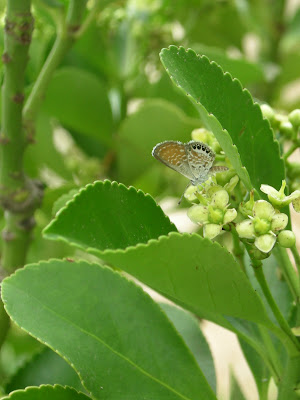
Western Pygmy-Blue (Brephidium exile), North America's smallest butterfly with a wingspan that may not even reach half an inch.

Reakirt's Blue (Echinargus isola)

Texan Crescent (Anthanassa texana)
We do have a porch light. As Heidi mentioned, there happens to be an active Barn Swallow (Hirundo rustica) nest using it as substrate. So we are going to have to come-up with another plan for attracting moths at least until that nest has fledged.
It is currently in incubation stage.
We've named the swallow Gladys. However, it has been observed that both parents share incubation duties.... how nice. So Gladys is female, and Gladys is male.
This is Gladys...., well, Sir Gladys I suppose:

Also, our first two groups of young Aplomado Falcons (Falco femoralis) arrive this afternoon!

We don't have internet at the house. We have to walk several blocks down slope to pirate wireless from a local business. With that in mind, plus once the falcons arrive we'll be going full-throttle, we aren't yet sure how regular our blog updates will become.
We will all just have to see.
At the moment it is partly cloudy, and the wildlife is happy. Particularly at a shrub in the front yard. SO many wasp species, a few net-winged beetles, and some familiar butterflies.
One of my favorite members of the wasp order, Hymenoptera, is the Cicada Killer (Sphecius spp):
These are huge 2+ inches long insects. When one hears within the monotony of the "whining cicadas" summer-long buzz a cicada quickly and individually deviate its contribution, likely it's due to an attack from Sphecius species.
One particularly interesting wasp family is Scoliidae. They are largish, hairy insects that are parasitic to larvae of scarab beetles.
Females dig around to uncover scarab larvae, lay an egg on it, and peace on out of there.
So many other wasp species on that particular shrub, so little time.
A few butterflies found their way on to it, all of which are very familiar:
Western Pygmy-Blue (Brephidium exile), North America's smallest butterfly with a wingspan that may not even reach half an inch.
Reakirt's Blue (Echinargus isola)
Texan Crescent (Anthanassa texana)
We do have a porch light. As Heidi mentioned, there happens to be an active Barn Swallow (Hirundo rustica) nest using it as substrate. So we are going to have to come-up with another plan for attracting moths at least until that nest has fledged.
It is currently in incubation stage.
We've named the swallow Gladys. However, it has been observed that both parents share incubation duties.... how nice. So Gladys is female, and Gladys is male.
This is Gladys...., well, Sir Gladys I suppose:
Also, our first two groups of young Aplomado Falcons (Falco femoralis) arrive this afternoon!
We don't have internet at the house. We have to walk several blocks down slope to pirate wireless from a local business. With that in mind, plus once the falcons arrive we'll be going full-throttle, we aren't yet sure how regular our blog updates will become.
We will all just have to see.
Subscribe to:
Posts (Atom)




 Posts
Posts