The first, a remarkably important topic tackled by Brooke McDonald. The second, a needed response.
http://blog.aba.org/2013/06/open-mic-the-field-glass-ceiling-women-mcdonald.html
http://paintedbunny.blogspot.com/2013/06/shards-of-glass.html
Bird on!
Showing posts with label birds. Show all posts
Showing posts with label birds. Show all posts
17 June 2013

24 March 2013
I-20 Wildlife Preserve
Without any intentional birding time scheduled, and no photos (whoops), I cobbled together a Texbirds post from March 18th's quick jaunt around the darn-new and mind-boggling site of Midland's new birding hotspot. Anyone wishing to attempt a birding trail, preserve, park, photography trail, whatever... this is a prime example of things done RIGHT. Quality blinds, trails, boardwalks and overlooks - not to mention feeding stations.
***
Folks unfamiliar with the new-ish I-20 Nature Preserve should really investigate it! Midland is somewhat short on birding options, but this one is conveniently wedged between Business 20, I-20, Midkiff and the loop; this means you will have zero sense of isolation (sounds like you're between two major highways, in fact), but the birding - and butterflying - definitely makes up for the noise of the machinery and general human chaos that surrounds it.
In a mid-afternoon jaunt on the 18th, Matt York and I kicked up nearly 30 species along the ~2 mile trail (mostly paved, some boardwalk) that runs the perimeter of the place. I lost count of blinds after the 4th or 5th - there are a few overlooks (2?) and a really sweet hawk tower. There are at least 2 RGV-style feeding stations that appear to be maintained daily as well. Someone has been writing roughly daily observations on their dry erase board and most of the bird/bug IDs appeared correct ("grackles" ...ah well)
http://www.
Also, pretty sure it's my new favorite place simply because it bans noise making and noise makers. Guess if you can't hear yourself think due to nearby human activity, the birds should get a break from artificial noise as well.
Happy trails,
-h
***
Folks unfamiliar with the new-ish I-20 Nature Preserve should really investigate it! Midland is somewhat short on birding options, but this one is conveniently wedged between Business 20, I-20, Midkiff and the loop; this means you will have zero sense of isolation (sounds like you're between two major highways, in fact), but the birding - and butterflying - definitely makes up for the noise of the machinery and general human chaos that surrounds it.
In a mid-afternoon jaunt on the 18th, Matt York and I kicked up nearly 30 species along the ~2 mile trail (mostly paved, some boardwalk) that runs the perimeter of the place. I lost count of blinds after the 4th or 5th - there are a few overlooks (2?) and a really sweet hawk tower. There are at least 2 RGV-style feeding stations that appear to be maintained daily as well. Someone has been writing roughly daily observations on their dry erase board and most of the bird/bug IDs appeared correct ("grackles" ...ah well)
http://www.
Also, pretty sure it's my new favorite place simply because it bans noise making and noise makers. Guess if you can't hear yourself think due to nearby human activity, the birds should get a break from artificial noise as well.
Happy trails,
-h
24 January 2013
Semi-annual Update
The 2012 review is up at Big Bend Nature.com and that means we're off the hook for more bird/bug updates for this post... right? Guess that leaves the pithy, lifey stuff...
Jan - hey, rare birds ARE life to us; Nutting's Flycatcher was some Herculean feat of masochism in spite of being a life bird for both of us. The bird called twice in something like two hours of our first observation and the call is what we HAD to record for confirmation. No pressure. Awesome bird. Great folks who chased it, as well. Kind of a who's who of birders, or an awkward family reunion.
Feb-May were somewhat nondescript, except when May rolled around we were both laid off from our part time jobs (same place - so there went our 20 hr/week gig, roughly 1/2 of our income, on 5 minutes notice... at the same time I lost my tutoring position due to graduation), but I guess at least we don't have to work at the checkpoint anymore! That was at the beginning of the week of finals and graduation. Not cool. I could have been studying!
Layoffs aside, May was wonderful; Matt's folks came out for my graduation and in the time-honored tradition of shirking rituals, I ate at CowDog instead of walking for graduation. Not quite a trip to the RGV (high school graduation), but CowDog with the best in-laws ever? Remarkably wonderful. We even introduced them to a black-tailed rattlesnake in the Chisos Basin! They stayed at Eve's Garden... not that we blogged their breakfast or anything. Ok, we did.
June saw a bit of travel; Matt held down the fort while I went to California for a wedding - not just any wedding, but that of a former solar car competitor turned bff/dear friend. While out there, I also managed to meet that 'new' nephew of mine who was already a year old! Whoops. I'm a bad aunt. Other than seeing a few birds during the wedding ceremony, no birding was done - but plenty of friends seen/met/stayed with in the process. Also, June was crafty... because I made a skirt into a dress for the wedding.
July was an exhausting/exhilarating mix of anticipation and phone-tag during the crunch time of pre-festival madness; Matt scouted and I wrangled field trip leaders and the most awesome celebrities ever, but between the two of us and some seriously awesome trip leaders, I'd say ~22 people at a first year birding festival with Kenn and Kimberly Kaufman is pretty much a success.
Following the festival, we took a week of down time and took the small dog to Santa Fe to meet her cousin. It was great to see the long-lost relatives (we see them maybe every 2-3 years or so). The fall turned into a busy mix of shipping Matt off to the AZ/CA border for some field work and I settled into my new job at Pitaya Verde.
The shift to winter was a mix of job shuffling again; Matt focused on guiding and contract work, I put my name in the hat for a librarian position. After Thanksgiving - early December for anyone keeping track - a neighbor told us about a house with a "for sale by owner" sign out front... and we've been throwing ourselves into it, full force, since then. We do enjoy the little house of termites, but the Double Bacon, as much as we love it, is sometimes just a bit too much. There's no closing date yet, but we're up to our ears in surveys, inspections, roof quotes and generic madness. Add the new job to the existing job and the move across town seems like quite a challenge. It's a pretty hefty move: all the way from the NE side to the SW side. A whopping 17 blocks... that's clear across town, as the maximum would have been 22 blocks if we'd lived any further on the NE side!
So please bear with us through blog silence as we tackle the latest batch of challenges: we're still here and our PO box won't change (434), but we're swamped with "productive" things!
Jan - hey, rare birds ARE life to us; Nutting's Flycatcher was some Herculean feat of masochism in spite of being a life bird for both of us. The bird called twice in something like two hours of our first observation and the call is what we HAD to record for confirmation. No pressure. Awesome bird. Great folks who chased it, as well. Kind of a who's who of birders, or an awkward family reunion.
Feb-May were somewhat nondescript, except when May rolled around we were both laid off from our part time jobs (same place - so there went our 20 hr/week gig, roughly 1/2 of our income, on 5 minutes notice... at the same time I lost my tutoring position due to graduation), but I guess at least we don't have to work at the checkpoint anymore! That was at the beginning of the week of finals and graduation. Not cool. I could have been studying!
Layoffs aside, May was wonderful; Matt's folks came out for my graduation and in the time-honored tradition of shirking rituals, I ate at CowDog instead of walking for graduation. Not quite a trip to the RGV (high school graduation), but CowDog with the best in-laws ever? Remarkably wonderful. We even introduced them to a black-tailed rattlesnake in the Chisos Basin! They stayed at Eve's Garden... not that we blogged their breakfast or anything. Ok, we did.
June saw a bit of travel; Matt held down the fort while I went to California for a wedding - not just any wedding, but that of a former solar car competitor turned bff/dear friend. While out there, I also managed to meet that 'new' nephew of mine who was already a year old! Whoops. I'm a bad aunt. Other than seeing a few birds during the wedding ceremony, no birding was done - but plenty of friends seen/met/stayed with in the process. Also, June was crafty... because I made a skirt into a dress for the wedding.
July was an exhausting/exhilarating mix of anticipation and phone-tag during the crunch time of pre-festival madness; Matt scouted and I wrangled field trip leaders and the most awesome celebrities ever, but between the two of us and some seriously awesome trip leaders, I'd say ~22 people at a first year birding festival with Kenn and Kimberly Kaufman is pretty much a success.
Following the festival, we took a week of down time and took the small dog to Santa Fe to meet her cousin. It was great to see the long-lost relatives (we see them maybe every 2-3 years or so). The fall turned into a busy mix of shipping Matt off to the AZ/CA border for some field work and I settled into my new job at Pitaya Verde.
The shift to winter was a mix of job shuffling again; Matt focused on guiding and contract work, I put my name in the hat for a librarian position. After Thanksgiving - early December for anyone keeping track - a neighbor told us about a house with a "for sale by owner" sign out front... and we've been throwing ourselves into it, full force, since then. We do enjoy the little house of termites, but the Double Bacon, as much as we love it, is sometimes just a bit too much. There's no closing date yet, but we're up to our ears in surveys, inspections, roof quotes and generic madness. Add the new job to the existing job and the move across town seems like quite a challenge. It's a pretty hefty move: all the way from the NE side to the SW side. A whopping 17 blocks... that's clear across town, as the maximum would have been 22 blocks if we'd lived any further on the NE side!
So please bear with us through blog silence as we tackle the latest batch of challenges: we're still here and our PO box won't change (434), but we're swamped with "productive" things!
 |
| Anakin, Matt, Nauga and Heidi - Jan 2013, photo by Tom Lehr |
05 December 2012
yard list revisited
No posts here since October!? Oh dear. We were tied up with the Rio Grande Valley Birding Festival in early November (leading trips this time around) and then were up in NW Missouri for Thanksgiving with the family, and now we're recovering from a Lubbock County Northern Shrike Chase (27 hrs, 2 of which were spent watching the bird!)
Since the last yard list update, whenever it was (apparently January), we've added a few things:
The Double Bacon - 9/1/10
1. Inca Dove 9/1/10
2. Eurasian Collared Dove 9/1/10
3. Barn Swallow 9/1/10
4. Turkey Vulture 9/3/10
5. Prairie Falcon 9/3/10
6. White-winged Dove 9/4/10
7. Cliff Swallow 9/4/10
8. American Kestrel 9/7/10
9. Bronzed Cowbird 9/7/10
10. House Finch 9/7/10
11. Common Nighthawk 9/7/10 -- FOS 5/19/11
12. Lesser Nighthawk 9/7/10 -- FOS 4/17/11
13. Great-tailed Grackle 9/9/10
14. Lesser Goldfinch 9/9/10
15. Western Tanager 9/10/10
16. Cave Swallow 9/14/10
17. House Sparrow 9/14/10 est
18. Wilson's Warbler 9/26/10
19. Osprey 9/26/10 - 4/2/11
20. Summer Tanager 9/26/10
21. Black-chinned Hummingbird 9/26/10 (back? 11, back early Mar '12)
22. Scissor-tailed Flycatcher 9/27/10
23. Broad-winged Hawk 9/27/10, (4/15/11) 4/23/11
24. Blue Grosbeak 9/27/10
25. Upland Sandpiper 9/27/10
26. Curve-billed Thrasher 9/27/10
27. Northern Rough-winged Swallow 9/28/10
28. Brewer's Blackbird 10/3/10
29. Cassin's Kingbird 10/4/10
30. Common Raven 10/5/10
31. Canyon Towhee 10/7/10
32. Northern Flicker 10/10/10
33. Chihuahuan Raven 10/16/10
34. Anna's Hummingbird 10/28* (ID on 31st)/10
35. Common Poorwill 11/9/10
36. Cedar Waxwing 11/19/10
37. Allen's Hummingbird 11/20/10 (?back ~11/20/11, banded 12/7/11)
38. Great Horned Owl 11/20/10 (est)
39. Red-naped Sapsucker 12/11/10
40. Verdin 12/11/10
41. Groove-billed Ani 12/18/10
42. Bewick's Wren 12/21/10
43. Sharp-shinned Hawk 1/5/11
44. Red-winged Blackbird 3/8/11
45. Hermit Thrush 3/18/11
46. Lark Bunting 3/30/11
47. Belted Kingfisher 3/31/11, 8/11/12
48. Chipping Sparrow 4/1/11
49. Vesper Sparrow 4/2/11
50. Zone-tailed Hawk 4/5/11
51. Scott's Oriole 4/10/11
52. Harris's Hawk 4/10/11
53. Broad-winged Hawk 4/16/11
54. Yellow-headed Blackbird 4/20/11
55. Pine Siskin 4/23/11
56. Swainson's Thrush 4/23/11
57. Ruby-throated Hummingbird 4/26/11, 9/17/12
58. Green-tailed Towhee 4/26/11
59. Painted Bunting 5/9/11
60. Gray Flycatcher 5/10/11
61. Willow Flycatcher 5/11/11
62. Black-throated Sparrow 5/11/11
63. Orchard Oriole 5/11/11
64. Western Wood-Pewee 5/12/11
65. MacGillivray's Warbler 5/13/11
66. Vermilion Flycatcher 5/15/11
67. Common Yellowthroat 5/15/11
68. Yellow Warbler 5/15/11
69. American Redstart 5/15/11
70. Varied Bunting 6/1/11
71. Say's Phoebe 6/12/11
72. Cooper's Hawk 7/17/11
73. Upland Sandpiper 8/14/11
74. Long-billed Curlew 8/15/11
75. Clay-colored Sparrow 9/12/11
76. Baltimore Oriole 9/18/11
77. Townsend's Warbler 9/19/11
78. Black-throated Blue Warbler 9/23/11
79. Black-crested Titmouse 10/5/11
80. Double-crested Cormorant 10/29/11
81. Killdeer 11/18/11
82. Brewer's Sparrow 11/30/11
83. American Crow 12/10/11
84. Dickcissel 12/ 11/11
85. Gray Catbird 12/11/11
86. Brown Creeper 12/11/11
87. Brown Thrasher 12/14/11, 10/3/12
88. Sage Thrasher 12/25/11
89. Common Ground Dove 1/8/12
90. Eastern Bluebird 5/16/12
91. Barn Owl 4/1/12
92. Cassin's Vireo 4/12/12
93. American Pipit 4/13/12
94. Franklin's Gull 5/8/12
95. Black-headed Grosbeak 5/10/12
96. Northern Waterthrush 5/11/12
97. Mississippi Kite 5/18/12, 9/21/12
98. Canyon Wren 7/30/12
99. Rock Wren 10/9/12 heard only
100. Merlin 10/19/12
101. Red Crossbill 11/27/12
Since the last yard list update, whenever it was (apparently January), we've added a few things:
The Double Bacon - 9/1/10
1. Inca Dove 9/1/10
2. Eurasian Collared Dove 9/1/10
3. Barn Swallow 9/1/10
4. Turkey Vulture 9/3/10
5. Prairie Falcon 9/3/10
6. White-winged Dove 9/4/10
7. Cliff Swallow 9/4/10
8. American Kestrel 9/7/10
9. Bronzed Cowbird 9/7/10
10. House Finch 9/7/10
11. Common Nighthawk 9/7/10 -- FOS 5/19/11
12. Lesser Nighthawk 9/7/10 -- FOS 4/17/11
13. Great-tailed Grackle 9/9/10
14. Lesser Goldfinch 9/9/10
15. Western Tanager 9/10/10
16. Cave Swallow 9/14/10
17. House Sparrow 9/14/10 est
18. Wilson's Warbler 9/26/10
19. Osprey 9/26/10 - 4/2/11
20. Summer Tanager 9/26/10
21. Black-chinned Hummingbird 9/26/10 (back? 11, back early Mar '12)
22. Scissor-tailed Flycatcher 9/27/10
23. Broad-winged Hawk 9/27/10, (4/15/11) 4/23/11
24. Blue Grosbeak 9/27/10
25. Upland Sandpiper 9/27/10
26. Curve-billed Thrasher 9/27/10
27. Northern Rough-winged Swallow 9/28/10
28. Brewer's Blackbird 10/3/10
29. Cassin's Kingbird 10/4/10
30. Common Raven 10/5/10
31. Canyon Towhee 10/7/10
32. Northern Flicker 10/10/10
33. Chihuahuan Raven 10/16/10
34. Anna's Hummingbird 10/28* (ID on 31st)/10
35. Common Poorwill 11/9/10
36. Cedar Waxwing 11/19/10
37. Allen's Hummingbird 11/20/10 (?back ~11/20/11, banded 12/7/11)
38. Great Horned Owl 11/20/10 (est)
39. Red-naped Sapsucker 12/11/10
40. Verdin 12/11/10
41. Groove-billed Ani 12/18/10
42. Bewick's Wren 12/21/10
43. Sharp-shinned Hawk 1/5/11
44. Red-winged Blackbird 3/8/11
45. Hermit Thrush 3/18/11
46. Lark Bunting 3/30/11
47. Belted Kingfisher 3/31/11, 8/11/12
48. Chipping Sparrow 4/1/11
49. Vesper Sparrow 4/2/11
50. Zone-tailed Hawk 4/5/11
51. Scott's Oriole 4/10/11
52. Harris's Hawk 4/10/11
53. Broad-winged Hawk 4/16/11
54. Yellow-headed Blackbird 4/20/11
55. Pine Siskin 4/23/11
56. Swainson's Thrush 4/23/11
57. Ruby-throated Hummingbird 4/26/11, 9/17/12
58. Green-tailed Towhee 4/26/11
59. Painted Bunting 5/9/11
60. Gray Flycatcher 5/10/11
61. Willow Flycatcher 5/11/11
62. Black-throated Sparrow 5/11/11
63. Orchard Oriole 5/11/11
64. Western Wood-Pewee 5/12/11
65. MacGillivray's Warbler 5/13/11
66. Vermilion Flycatcher 5/15/11
67. Common Yellowthroat 5/15/11
68. Yellow Warbler 5/15/11
69. American Redstart 5/15/11
70. Varied Bunting 6/1/11
71. Say's Phoebe 6/12/11
72. Cooper's Hawk 7/17/11
73. Upland Sandpiper 8/14/11
74. Long-billed Curlew 8/15/11
75. Clay-colored Sparrow 9/12/11
76. Baltimore Oriole 9/18/11
77. Townsend's Warbler 9/19/11
78. Black-throated Blue Warbler 9/23/11
79. Black-crested Titmouse 10/5/11
80. Double-crested Cormorant 10/29/11
81. Killdeer 11/18/11
82. Brewer's Sparrow 11/30/11
83. American Crow 12/10/11
84. Dickcissel 12/ 11/11
85. Gray Catbird 12/11/11
86. Brown Creeper 12/11/11
87. Brown Thrasher 12/14/11, 10/3/12
88. Sage Thrasher 12/25/11
89. Common Ground Dove 1/8/12
90. Eastern Bluebird 5/16/12
91. Barn Owl 4/1/12
92. Cassin's Vireo 4/12/12
93. American Pipit 4/13/12
94. Franklin's Gull 5/8/12
95. Black-headed Grosbeak 5/10/12
96. Northern Waterthrush 5/11/12
97. Mississippi Kite 5/18/12, 9/21/12
98. Canyon Wren 7/30/12
99. Rock Wren 10/9/12 heard only
100. Merlin 10/19/12
101. Red Crossbill 11/27/12
31 May 2012

01 April 2012
Learning bird calls by ear
This is one of the most informative videos about birding by ear that I've ever seen:
26 February 2012
BirdTape and why it should be on your windows.
The American Bird Conservancy has produced a fantastic new product: BirdTape.
Ultimately, windows kill more birds in the US than all other forms of human-related bird deaths (cats, cars, wind turbines, etc), combined. Indeed, it is speculated that many cat kills were stunned from hitting windows first. Many stunned birds who are lucky enough to escape cats still fly away and many die later of internal injuries.
Here's their instructional video:
Be sure to check out the video at the bottom of their collisions page!!
Considering that the Germans have been working on this for years because their sound barriers along highways tend to be glass, it has taken quite a while for the idea to spread. Here are a few pictures from my 2008 trip, starting with a shelter at a train station that was built before the idea caught on - but still has falcon silhouette stickers!

Apologies for the quality of these, they're both taken from inside moving trains. This second design would have been more bird friendly if the stripes were vertical instead of horizontal, but the aesthetic appeal would probably have been decreased. For all practical purposes, though, it will do its job far better than the few stickers on the shelter above!

For a reminder: most buildings have this problem to one degree or another. Here's a kindergarten/elementary school that uses bird stickers and big, bright paper cutouts to prevent bird/people window strikes.

And for grown-ups, here's the airport in Koln: the main building is huge glass panels without any visible sign of stickers or fritting or bird-friendly modifications. Yet the air vents near the parking lot are surrounded by glass panels as well, and they have designs that are about as effective as bird stickers (read: better than nothing, but not by much).

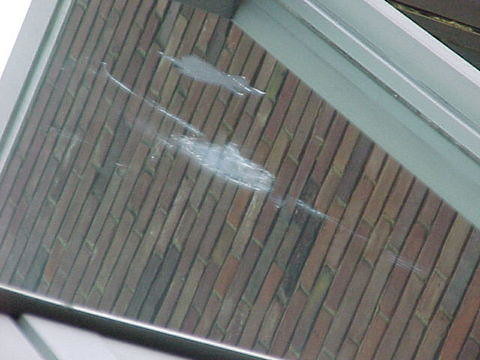
So if you have issues with your windows, don't waste your effort on band-aid fixes like one or two stickers per window - you will have bird prints between the stickers:
Related links:
Problems with Windows
10 Things You Can Do To Reduce Bird vs. Window Collisions
A window into the perils of migration
Seetrail links:
Tis the season; a bird is trying to get into my house
When birds hit windows
Another option: shade structures. A bit more expensive than tape.

Conclusion? My name is Heidi, and I am a window tourist.

(x-posted at Big Bend Birds & Nature)
Ultimately, windows kill more birds in the US than all other forms of human-related bird deaths (cats, cars, wind turbines, etc), combined. Indeed, it is speculated that many cat kills were stunned from hitting windows first. Many stunned birds who are lucky enough to escape cats still fly away and many die later of internal injuries.
Here's their instructional video:
Be sure to check out the video at the bottom of their collisions page!!
Considering that the Germans have been working on this for years because their sound barriers along highways tend to be glass, it has taken quite a while for the idea to spread. Here are a few pictures from my 2008 trip, starting with a shelter at a train station that was built before the idea caught on - but still has falcon silhouette stickers!
Apologies for the quality of these, they're both taken from inside moving trains. This second design would have been more bird friendly if the stripes were vertical instead of horizontal, but the aesthetic appeal would probably have been decreased. For all practical purposes, though, it will do its job far better than the few stickers on the shelter above!
For a reminder: most buildings have this problem to one degree or another. Here's a kindergarten/elementary school that uses bird stickers and big, bright paper cutouts to prevent bird/people window strikes.
And for grown-ups, here's the airport in Koln: the main building is huge glass panels without any visible sign of stickers or fritting or bird-friendly modifications. Yet the air vents near the parking lot are surrounded by glass panels as well, and they have designs that are about as effective as bird stickers (read: better than nothing, but not by much).
So if you have issues with your windows, don't waste your effort on band-aid fixes like one or two stickers per window - you will have bird prints between the stickers:
Related links:
Problems with Windows
10 Things You Can Do To Reduce Bird vs. Window Collisions
A window into the perils of migration
Seetrail links:
Tis the season; a bird is trying to get into my house
When birds hit windows
Another option: shade structures. A bit more expensive than tape.
Conclusion? My name is Heidi, and I am a window tourist.
(x-posted at Big Bend Birds & Nature)
14 February 2012
just links
For folks who are seeking wildlife rehab, here's a directory link that also has some useful tips.
For an eloquent write-up on the scientific value of dead birds, "So You Found a Dead Bird" says things a bit better than I generally do. I would say that in some cases, there is such a thing as too common (but probably not for under-studied counties), and there is such a thing as "too far gone" for roadkill/decay/etc - but that also depends on the bird. Snow Bunting roadkill in TX? Only a wing or leg still 3D? Bring it in!
For an eloquent write-up on the scientific value of dead birds, "So You Found a Dead Bird" says things a bit better than I generally do. I would say that in some cases, there is such a thing as too common (but probably not for under-studied counties), and there is such a thing as "too far gone" for roadkill/decay/etc - but that also depends on the bird. Snow Bunting roadkill in TX? Only a wing or leg still 3D? Bring it in!
04 February 2012
It's not silence, just productivity!
Folks may have noticed that our other blog, Big Bend Birds & Nature, is getting all of the love. Not so! Well, mostly, but along with the quiet over here and a bit of a slow down in posting over there (it's all relative, right?) is continued adventure with Sul Ross State University and a pile of brain-crunching for a summer birding event in Marathon. The Sul Ross madness now involves a Dean's List and an actual 4.0 GPA for 35 hours there so far with 9 more in the works. English/reading/writing tutoring still exists on the side as well.
So what about that summer birding event? Keep the latter half of July bookmarked and we'll have details as soon as possible!
And a consolation Nutting's Flycatcher from last month, for folks who missed it:

So what about that summer birding event? Keep the latter half of July bookmarked and we'll have details as soon as possible!
And a consolation Nutting's Flycatcher from last month, for folks who missed it:

16 January 2012
about that yard list
Our yard list was last updated on the blog in... May.
So here's the next batch!
Varied Bunting 6/1/11
Say's Phoebe 6/12/11
Cooper's Hawk 7/17/11
Upland Sandpiper 8/14/11
Long-billed Curlew 8/15/11
Clay-colored Sparrow 9/12/11
Baltimore Oriole 9/18/11
Townsend's Warbler 9/19/11
Black-throated Blue Warbler 9/23/11
Black-crested Titmouse 10/5/11
Double-crested Cormorant 10/29/11
Killdeer 11/18/11
Brewer's Sparrow 11/30/11
American Crow 12/10/11
Dickcissel 12/ 11/11
Gray Catbird 12/11/11
Brown Creeper 12/11/11
Brown Thrasher 12/14/11
Sage Thrasher 12/25/11
Common Ground Dove 1/8/12
...this puts us at 88 species for the yard since 9/1/10 - not too bad!
So here's the next batch!
Varied Bunting 6/1/11
Say's Phoebe 6/12/11
Cooper's Hawk 7/17/11
Upland Sandpiper 8/14/11
Long-billed Curlew 8/15/11
Clay-colored Sparrow 9/12/11
Baltimore Oriole 9/18/11
Townsend's Warbler 9/19/11
Black-throated Blue Warbler 9/23/11
Black-crested Titmouse 10/5/11
Double-crested Cormorant 10/29/11
Killdeer 11/18/11
Brewer's Sparrow 11/30/11
American Crow 12/10/11
Dickcissel 12/ 11/11
Gray Catbird 12/11/11
Brown Creeper 12/11/11
Brown Thrasher 12/14/11
Sage Thrasher 12/25/11
Common Ground Dove 1/8/12
...this puts us at 88 species for the yard since 9/1/10 - not too bad!
26 November 2011
That Eagle Optics shirt?
The previous post showed a mere outline of the awesome-yet-to-come:

The actual screening on the shirt, of course, is by Louise Zemaitis - now autographed, initialed and accompanied by fangirl antics. Who knew birders had such rabid fans? Oh, wait.

Sleeve art by Michael O'Brien... how awesome is that? Clearly another perched Black-and-white Warbler would have been too boring, but way to one-up the original art!

The actual screening on the shirt, of course, is by Louise Zemaitis - now autographed, initialed and accompanied by fangirl antics. Who knew birders had such rabid fans? Oh, wait.

Sleeve art by Michael O'Brien... how awesome is that? Clearly another perched Black-and-white Warbler would have been too boring, but way to one-up the original art!
17 November 2011
RGV Birding Festival
We may or may not have seriously nerded it up over the weekend:
Louise Zemaitis autographed her Black-and-white Warbler shirt
Michael O'Brien drew another Black-and-white Warbler on the sleeve of the shirt
Jon Dunn autographed the newest Nat. Geo. on our honeymoon spindalis page
...and we wrangled a booth all weekend, too!


Louise Zemaitis autographed her Black-and-white Warbler shirt
Michael O'Brien drew another Black-and-white Warbler on the sleeve of the shirt
Jon Dunn autographed the newest Nat. Geo. on our honeymoon spindalis page
...and we wrangled a booth all weekend, too!


05 November 2011
The "why" of window monitoring
Birds hit windows. It's pretty much impossible to overstate the extent of the issue. Pretty much everyone knows that it happens but very few people look beyond face value of the smudge on glass.
This is more eloquent than anything I've seen yet, so please take a look at
Tim O'Connell's piece: A window into the perils of migration. He beautifully outlines the "how" and "why" of dead birds as educational tools, as well as one example of the mind boggling architecture that causes such high mortality rates. Flat-sided buildings are bad enough, but a horseshoe with a 'corridor effect' cluster at one end? Yikes!
On a coincidental note, I'm about half way into a paper on the complexities of North American window collisions - they've been my constant companion since 2003 and I need to get my thoughts out of my head and into writing. Unfortunately it's a rather dry, sciency sort of writing, but I think the discussion will be helpful. It's just terribly difficult to keep citations sorted out since there are about 20 papers that cite each other ad infinitum and the resulting citation loop is frustrating. One paper that I criticize lists my paper in its citations, too, for that matter!
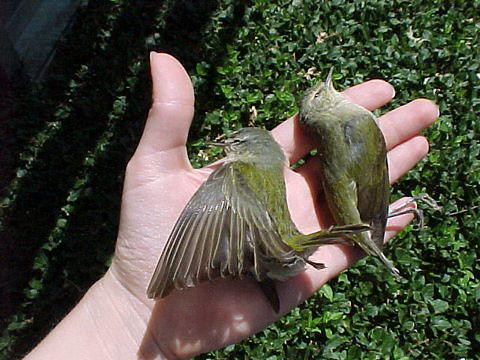
Anyway, here are some lovelies - Tennessee Warblers - from Principia, circa 2004-2005 (a tiny fraction of the actual species diversity and even fewer of the overall body count.)
External link: dead bird album
This is also cross-posted over at Big Bend Birds & Nature.
This is more eloquent than anything I've seen yet, so please take a look at
Tim O'Connell's piece: A window into the perils of migration. He beautifully outlines the "how" and "why" of dead birds as educational tools, as well as one example of the mind boggling architecture that causes such high mortality rates. Flat-sided buildings are bad enough, but a horseshoe with a 'corridor effect' cluster at one end? Yikes!
On a coincidental note, I'm about half way into a paper on the complexities of North American window collisions - they've been my constant companion since 2003 and I need to get my thoughts out of my head and into writing. Unfortunately it's a rather dry, sciency sort of writing, but I think the discussion will be helpful. It's just terribly difficult to keep citations sorted out since there are about 20 papers that cite each other ad infinitum and the resulting citation loop is frustrating. One paper that I criticize lists my paper in its citations, too, for that matter!
Anyway, here are some lovelies - Tennessee Warblers - from Principia, circa 2004-2005 (a tiny fraction of the actual species diversity and even fewer of the overall body count.)
External link: dead bird album
This is also cross-posted over at Big Bend Birds & Nature.
17 August 2011
August update
Last week we were asked to speak about the impact of drought on birds and other wildlife on Marfa Public Radio; the audio has been archived and can now be accessed anywhere, at any time, should you feel the urge.
Photo/permalink via Marfa Public Radio:

Handy links from previous posts on the Big Bend Birds & Nature blog:
the drying, the drought (a bit heavy, but eye-opening)
in the meantime, pictures
freezer catch-up
and an optimistic final note: drought?
...in the meantime, things are keeping a hectic pace that neither blog quite reflects. We'd promise more updates if we knew there would be any soonish, but that's a long shot! Perhaps photos of some furniture projects one of these days, though...
Photo/permalink via Marfa Public Radio:
Handy links from previous posts on the Big Bend Birds & Nature blog:
the drying, the drought (a bit heavy, but eye-opening)
in the meantime, pictures
freezer catch-up
and an optimistic final note: drought?
...in the meantime, things are keeping a hectic pace that neither blog quite reflects. We'd promise more updates if we knew there would be any soonish, but that's a long shot! Perhaps photos of some furniture projects one of these days, though...
16 July 2011
near and dear to my hawk tower
I wondered if this day might come: the Smith Point Hawk Watch is basically losing funding for a season. It is a brilliant place to see raptor migration but counting hawks there is like trying to count spaghetti as they boil! Falcons and kites are a MUCH more reliable count, but the location is prime for kettling Wood Storks and Magnificent Frigatebirds at the same time.
It is where I 'cut my teeth' with raptors in high school, spent the better part of a fall after Prin and have followed every snippet of its life through hurricanes and budget ails. For birds, for bugs, for life, Smith Point is not to be ignored.
***
Subject: Smith Point Hawk Watch
From: Susan Heath sheath/GCBO.ORG
Date: Fri, 15 Jul 2011 15:07:08 -0500
TexBirders,
We have been warned by our leaders that belt-tightening must take place and that all will feel a little of the squeeze. That reality has hit GCBO's Research Program for the coming year. To be honest it has always been a touch-and-go situation when it comes to raising the resources necessary to fund the important Smith Point Hawk Watch, and some years GCBO has had to swallow much of the cost, draining funds away from other, equally important programs. The season, our 15th, we have had to make a lemons-to-lemonade situation on the raptor migration monitoring project. In the past, the cost of the hawk watch was shared between Hawk Watch International and GCBO. This year neither party was able to raise the necessary funds to cover the expenses associated with running the hawk watch. Therefore we have decided to do two things: (1) try to keep the count going with volunteers, and (2) change the focus of the count a bit. We have decided to focus on the Swallow-tailed Kite, since Smith Point is strategically located to sample much of the southward migration of this vulnerable iconic symbol of the southern bottomlands. Kites migrate earlier than other raptors so we will begin the season on August 1st instead of the 15th as in the past. The Swallow-tailed Kite migration is largely over by October 1st so we will concentrate on that 60-day period initially. Several intrepid volunteers from past seasons have already volunteered to cover much of that period, but we need a few more volunteers to fill out the calendar. Several volunteers have agreed to continue counting through November 15, to keep this season's data comparable to previous years. Last, but to some by no means least, if in past Smith Point seasons you were in the habit of swinging by the tower to use the sanitary facilities, don't bother. Sadly that has been a casualty of belt-tightening this season also. We are checking with local officials to see if any one else can support that need.
If you have hawk watch experience and would like to volunteer, please check the calendar at:
http://tinyurl.com/6ehoh3o
If you are available for any of the open dates, please e-mail Sue at sheath AT gcbo.org and let her know of your preference. We really appreciate the efforts of all our volunteers to help keep the Smith Point Hawk Watch alive. We have high hopes that we will be able to raise funding to resume with paid counters next year. To that end, if you would like to make a contribution to the hawk watch or know of other organizations that can, we would really appreciate the support. You can make a donation at:
https://www.justgive.org/nonprofits/donate.jsp?ein=76-0553113
and specify Smith Point Hawk Watch or mail a check to the address below. Thanks for your support everyone!
Sue Heath & John Arvin
Susan A. Heath, Ph.D.
Avian Conservation Biologist
Gulf Coast Bird Observatory
103 W. Hwy 332
Lake Jackson, TX 77566
979-480-0999
Join us in our quest to study and conserve birds and their habitat around the Gulf of Mexico.
www.gcbo.org
Sign-Up for our monthly E-News Letter
http://www.gcbo.org/default.aspx/MenuItemID/205/MenuGroup/Home.htm
It is where I 'cut my teeth' with raptors in high school, spent the better part of a fall after Prin and have followed every snippet of its life through hurricanes and budget ails. For birds, for bugs, for life, Smith Point is not to be ignored.
***
Subject: Smith Point Hawk Watch
From: Susan Heath sheath/GCBO.ORG
Date: Fri, 15 Jul 2011 15:07:08 -0500
TexBirders,
We have been warned by our leaders that belt-tightening must take place and that all will feel a little of the squeeze. That reality has hit GCBO's Research Program for the coming year. To be honest it has always been a touch-and-go situation when it comes to raising the resources necessary to fund the important Smith Point Hawk Watch, and some years GCBO has had to swallow much of the cost, draining funds away from other, equally important programs. The season, our 15th, we have had to make a lemons-to-lemonade situation on the raptor migration monitoring project. In the past, the cost of the hawk watch was shared between Hawk Watch International and GCBO. This year neither party was able to raise the necessary funds to cover the expenses associated with running the hawk watch. Therefore we have decided to do two things: (1) try to keep the count going with volunteers, and (2) change the focus of the count a bit. We have decided to focus on the Swallow-tailed Kite, since Smith Point is strategically located to sample much of the southward migration of this vulnerable iconic symbol of the southern bottomlands. Kites migrate earlier than other raptors so we will begin the season on August 1st instead of the 15th as in the past. The Swallow-tailed Kite migration is largely over by October 1st so we will concentrate on that 60-day period initially. Several intrepid volunteers from past seasons have already volunteered to cover much of that period, but we need a few more volunteers to fill out the calendar. Several volunteers have agreed to continue counting through November 15, to keep this season's data comparable to previous years. Last, but to some by no means least, if in past Smith Point seasons you were in the habit of swinging by the tower to use the sanitary facilities, don't bother. Sadly that has been a casualty of belt-tightening this season also. We are checking with local officials to see if any one else can support that need.
If you have hawk watch experience and would like to volunteer, please check the calendar at:
http://tinyurl.com/6ehoh3o
If you are available for any of the open dates, please e-mail Sue at sheath AT gcbo.org and let her know of your preference. We really appreciate the efforts of all our volunteers to help keep the Smith Point Hawk Watch alive. We have high hopes that we will be able to raise funding to resume with paid counters next year. To that end, if you would like to make a contribution to the hawk watch or know of other organizations that can, we would really appreciate the support. You can make a donation at:
https://www.justgive.org/nonprofits/donate.jsp?ein=76-0553113
and specify Smith Point Hawk Watch or mail a check to the address below. Thanks for your support everyone!
Sue Heath & John Arvin
Susan A. Heath, Ph.D.
Avian Conservation Biologist
Gulf Coast Bird Observatory
103 W. Hwy 332
Lake Jackson, TX 77566
979-480-0999
Join us in our quest to study and conserve birds and their habitat around the Gulf of Mexico.
www.gcbo.org
Sign-Up for our monthly E-News Letter
http://www.gcbo.org/default.aspx/MenuItemID/205/MenuGroup/Home.htm
15 May 2011
The Yard List that keeps going...
I know I posted about yard lists a while back, but the last few weeks have been quite something! The Jan/Feb lull was a time of complacency (and frozen pipes) but spring seems to have hit right along with the 90+ degree days. Thankfully it's been cooling off nicely in the evenings, but for those of y'all not following our other blog, you may not have realized that most of the three counties out here have pretty much been, at least in part, on fire since early March. The fire just to our north, Iron Mountain, is about 8 miles out and has been going for around a week. Somewhere in the vicinity of 50,000 acres have burned and it's still only about 80% contained. On the bright side, the Rock House Fire is FINALLY out (after a bit over a month!) as of a few days ago. Oof!
Right, back to the bird list, starting where we left off:
Zone-tailed Hawk 4/5/11
Scott's Oriole 4/10/11
Harris's Hawk 4/10/11
Broad-winged Hawk 4/16/11
Yellow-headed Blackbird 4/20/11
Pine Siskin 4/23/11
Swainson's Thrush 4/23/11
Ruby-throated Hummingbird 4/26/11
Green-tailed Towhee 4/26/11
Painted Bunting 5/9/11
Gray Flycatcher 5/10/11
Willow Flycatcher 5/11/11
Black-throated Sparrow 5/11/11
Orchard Oriole 5/11/11
Western Wood-Pewee 5/12/11
MacGillivray's Warbler 5/13/11
Vermilion Flycatcher 5/15/11
Common Yellowthroat 5/15/11
Yellow Warbler 5/15/11
American Redstart 5/15/11
***
I should also throw in this gem of trivia: 95 bird species are on my tentative 'expanded' freezer list (to include wildlife work and rehab, but not captive zoo work nor pets). Most seem to be roadkill, but windows overlap a good bit (I knew I had 47 or 48 spp from Illinois, and now there are a few more window critters to add...)
Really, though, it's either impressive or depressing that roughly 20% of the bird species I've ever seen in the US have at one time or another been in a freezer that I've been associated with. Can't believe I didn't make/start the list sooner, it seems like something I'd do. At this rate, I'll have filled up a few chest freezers over the course of my rather short lifetime; every one of them 'salvaged' (not actively 'collected' with gun or trap).
To avoid ending on such a strange note, here's a Painted Bunting! She's alive, stunned, but otherwise uninjured. Found her in the middle of the road to Fort Stockton on my way to Houston earlier in the month. Houston? I guess that trip needs a post one of these days, too!

Right, back to the bird list, starting where we left off:
Zone-tailed Hawk 4/5/11
Scott's Oriole 4/10/11
Harris's Hawk 4/10/11
Broad-winged Hawk 4/16/11
Yellow-headed Blackbird 4/20/11
Pine Siskin 4/23/11
Swainson's Thrush 4/23/11
Ruby-throated Hummingbird 4/26/11
Green-tailed Towhee 4/26/11
Painted Bunting 5/9/11
Gray Flycatcher 5/10/11
Willow Flycatcher 5/11/11
Black-throated Sparrow 5/11/11
Orchard Oriole 5/11/11
Western Wood-Pewee 5/12/11
MacGillivray's Warbler 5/13/11
Vermilion Flycatcher 5/15/11
Common Yellowthroat 5/15/11
Yellow Warbler 5/15/11
American Redstart 5/15/11
***
I should also throw in this gem of trivia: 95 bird species are on my tentative 'expanded' freezer list (to include wildlife work and rehab, but not captive zoo work nor pets). Most seem to be roadkill, but windows overlap a good bit (I knew I had 47 or 48 spp from Illinois, and now there are a few more window critters to add...)
Really, though, it's either impressive or depressing that roughly 20% of the bird species I've ever seen in the US have at one time or another been in a freezer that I've been associated with. Can't believe I didn't make/start the list sooner, it seems like something I'd do. At this rate, I'll have filled up a few chest freezers over the course of my rather short lifetime; every one of them 'salvaged' (not actively 'collected' with gun or trap).
To avoid ending on such a strange note, here's a Painted Bunting! She's alive, stunned, but otherwise uninjured. Found her in the middle of the road to Fort Stockton on my way to Houston earlier in the month. Houston? I guess that trip needs a post one of these days, too!

19 April 2011
About that "tickled" penguin...
A snippet of the above video has been circulating with the "tickled penguin" tag - the first minute is just an introduction of Cookie, a little fellow with bumblefoot on his right foot (which is bandaged). From the one minute mark on, it's... well... Cookie working his penguin charms on the hand of an unidentified object of affection.
*cough*
Yeah, tickling. That's what the kids call it these days...
12 April 2011
Window kill: Lark Bunting
Of the creatures inhabiting our freezer, Lark Bunting (Calamospiza melanocorys) was one I didn't anticipate would have been a window kill. Most Lark Buntings are seen in distant flocks, uttering a feeble "what? wheep?" sort of call; this female is far closer than any I'd ever have expected to see. Bird-in-hand is an interesting departure from in-field observation.
A dear neighbor found it at a residence on the west side of town... she brought it to me and we discovered a few things. Lark Buntings have two different shades of down feathers. Gray under the back, black under the belly. The outermost four primaries are nearly black, the rest are dark brown.


Note: state and/or federal permits are required to pick up birds.
Our permits are through Texas A&M; the collection date for this bunting was 1 April, 2011 from NW Marathon, Brewster Co. Texas.
A dear neighbor found it at a residence on the west side of town... she brought it to me and we discovered a few things. Lark Buntings have two different shades of down feathers. Gray under the back, black under the belly. The outermost four primaries are nearly black, the rest are dark brown.


Note: state and/or federal permits are required to pick up birds.
Our permits are through Texas A&M; the collection date for this bunting was 1 April, 2011 from NW Marathon, Brewster Co. Texas.
11 April 2011
Roadkill: Loggerhead Shrike
Since the freezer is getting crowded, it seems like a good time to share a few more of the inhabitants... it's educational, or something. Perhaps this would be a good time for Matt to post about these lovelies and how they earned their "butcher bird" nickname. A closeup on that beak perhaps gives a slight indication?
Without further fuss, SeeTrail presents Roadkill: Loggerhead Shrike (Lanius ludovicianus) - a predatory songbird of open areas and pointy shrubs; all the better to impale prey upon.


Note: state and/or federal permits are required to pick up birds.
Our permits are through Texas A&M; this shrike was collected with their permit ~20 miles north of Study Butte, Texas on 23 March, 2011.
Without further fuss, SeeTrail presents Roadkill: Loggerhead Shrike (Lanius ludovicianus) - a predatory songbird of open areas and pointy shrubs; all the better to impale prey upon.


Note: state and/or federal permits are required to pick up birds.
Our permits are through Texas A&M; this shrike was collected with their permit ~20 miles north of Study Butte, Texas on 23 March, 2011.
10 April 2011
Tis the season; a bird is trying to get into my house
This photo is neither flattering to subject nor situation; you'll have to assume that the window is as darkly tinted and highly reflective as any window can possibly be. The building is not a house in this case, but the gift shop at the Persimmon Gap entrance to Big Bend National Park. The title stands for weary googlers who are searching for a reason that a bird might be trying to get into their houses and/or attacking their windows (and side mirrors on cars! Easily enough prevented with paper or plastic bag securely placed over side mirrors, but then shiny hubcaps get the attention...)
The charming, witty, amorous suitor in the photo below is a Common Raven, making soft gutteral noises and bill-clacking to the lovely, svelte raven-in-the-mirror. At least we can only assume that charming and witty are attractive to ravens... the sweet nothings sure sounded charming.

Many of the questions I get about birds & windows are based on the assumption that the bird is actively trying to get into their house. Having not seen every situation on the planet, I can't rule that out, but in every situation that I've personally seen, the bird "trying to get in" is either defending territory by trying to attack the intruder it sees (itself), or, as is the case with the raven above... the poor critter just wants to say 'hello' to the attractive creature in the reflection.
The instinct for a bird to approach its reflection is pretty basic, like a baby in front of a mirror. There is no need for fear, panic, alarm, etc. While taping a piece of paper over the window might stop the bird from attacking that particular spot... well, there's still the rest of the window, right? This is good and bad; it means the bird can still attack a lot of window, but it also means that there's a lot of room to play.
Click here for an example of a Northern Cardinal attacking a window - via birds and buildings.org ...apologies for the gratuitous linking, as their photo is from my first round of undergrad adventures, but it demonstrates the "single piece of paper" theory in action (and failure).
One of the most simple examples of effective bird deterrence is this: the humble post-it note. Spacing them in a checkerboard pattern across the inside of a window is about as temporary and easy as it gets. Depending on the bird, it may only try to attack the window for a week or two; some may express territorial behaviors for a month or more.

Both of the post-it note photos are courtesy of Pauline Saribas, who used the design to prevent lethal window strikes (as opposed to territorial strikes) - but the idea is the same; make the window as unattractive of a suitor/challenger/flying space as possible. The large "x" shape is unlikely to deter many strikes, lethal or not, because there's too much room around the shape, but if the entire surface was checkered the number of strikes would certainly go down. Hopefully the best "attacking" spots would be well concealed, thus ending the reign of Pecking Cardinal, Swooping Flycatcher, Flailing Mockingbird, and Heartthrob Raven.

While a bird attacking a window is a nuisance to humans, perhaps, it is a distraction from what the bird should be doing - raising young, defending their territory from real birds, and generally going about their business. It is NEVER acceptable to kill the bird as a "solution" - it dooms their offspring and is illegal.
Go with the easy on, easy off, inexpensive, temporary and otherwise humane option of post-it notes. You can unleash your creativity with bright colors, bold patterns, crafting them into fun shapes and designs, and maybe even get the territorial bird away from your window(s). It could, however, get your neighbors wondering!
Other sites relevant to birds and windows:
FLAP.org has a section on "prevent window kills" with some very nifty links - they address a lot of things that do *and* don't work, as well as *why*
Project BirdSafe - for home & office - you don't have to be in Minnesota to appreciate their guidance!
This is geared mostly toward architects, but under "INFORMATION ABOUT
BIRD-SAFE DESIGNS" the "solution options" have some really cool
examples of modified windows - birdsandbuildings.org
Feel free to leave a comment or drop an e-mail if you'd like help addressing collision issues - territory or otherwise - it's always worth kicking around ideas to find what works in different situations!
The charming, witty, amorous suitor in the photo below is a Common Raven, making soft gutteral noises and bill-clacking to the lovely, svelte raven-in-the-mirror. At least we can only assume that charming and witty are attractive to ravens... the sweet nothings sure sounded charming.

Many of the questions I get about birds & windows are based on the assumption that the bird is actively trying to get into their house. Having not seen every situation on the planet, I can't rule that out, but in every situation that I've personally seen, the bird "trying to get in" is either defending territory by trying to attack the intruder it sees (itself), or, as is the case with the raven above... the poor critter just wants to say 'hello' to the attractive creature in the reflection.
The instinct for a bird to approach its reflection is pretty basic, like a baby in front of a mirror. There is no need for fear, panic, alarm, etc. While taping a piece of paper over the window might stop the bird from attacking that particular spot... well, there's still the rest of the window, right? This is good and bad; it means the bird can still attack a lot of window, but it also means that there's a lot of room to play.
Click here for an example of a Northern Cardinal attacking a window - via birds and buildings.org ...apologies for the gratuitous linking, as their photo is from my first round of undergrad adventures, but it demonstrates the "single piece of paper" theory in action (and failure).
One of the most simple examples of effective bird deterrence is this: the humble post-it note. Spacing them in a checkerboard pattern across the inside of a window is about as temporary and easy as it gets. Depending on the bird, it may only try to attack the window for a week or two; some may express territorial behaviors for a month or more.

Both of the post-it note photos are courtesy of Pauline Saribas, who used the design to prevent lethal window strikes (as opposed to territorial strikes) - but the idea is the same; make the window as unattractive of a suitor/challenger/flying space as possible. The large "x" shape is unlikely to deter many strikes, lethal or not, because there's too much room around the shape, but if the entire surface was checkered the number of strikes would certainly go down. Hopefully the best "attacking" spots would be well concealed, thus ending the reign of Pecking Cardinal, Swooping Flycatcher, Flailing Mockingbird, and Heartthrob Raven.

While a bird attacking a window is a nuisance to humans, perhaps, it is a distraction from what the bird should be doing - raising young, defending their territory from real birds, and generally going about their business. It is NEVER acceptable to kill the bird as a "solution" - it dooms their offspring and is illegal.
Go with the easy on, easy off, inexpensive, temporary and otherwise humane option of post-it notes. You can unleash your creativity with bright colors, bold patterns, crafting them into fun shapes and designs, and maybe even get the territorial bird away from your window(s). It could, however, get your neighbors wondering!
Other sites relevant to birds and windows:
FLAP.org has a section on "prevent window kills" with some very nifty links - they address a lot of things that do *and* don't work, as well as *why*
Project BirdSafe - for home & office - you don't have to be in Minnesota to appreciate their guidance!
This is geared mostly toward architects, but under "INFORMATION ABOUT
BIRD-SAFE DESIGNS" the "solution options" have some really cool
examples of modified windows - birdsandbuildings.org
Feel free to leave a comment or drop an e-mail if you'd like help addressing collision issues - territory or otherwise - it's always worth kicking around ideas to find what works in different situations!
Subscribe to:
Posts (Atom)




 Posts
Posts