Edit: The RBA portion was originally posted 7/29/09 at 8:45 pm,
then censored upon request for the sake of nest privacy, and is now back as the unedited RBA submission with some discussion. I cannot thank Patricia Auffhammer enough for keeping us in the loop as to the progression of events, every update has been a refreshing reminder of our sweltering mosquito adventure.

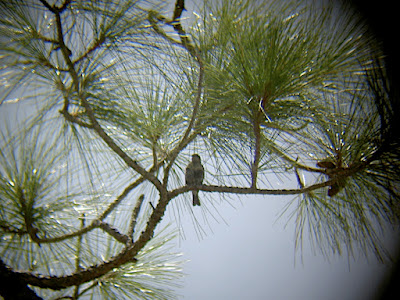
(the original super-awesome digi-bin photo)
Below is the result of your feedback form. It was submitted by Heidi Trudell & Matthew York on Wednesday, July 29, 2009 9:44 PM
---------------------------------------------------------------------------
01. Common Name Western Spindalis
02. Scientific Name Spindalis zena
03. Number Of Individuals: 2
04. Age: adult
05. Sex: male and female
06. Date Observed: July 28, 2009
07. Time Of Day: Noon
08. Duration Of Observation: 45 minutes
09. Sky Conditions: Bright and clear
10. Exact Location: [the birds are still around, and in a sensitive state right now - fledging - and the folks who currently have the locations posted should think long and hard about raising little ones]
11. Habitat: Pine flatwoods with mixed palmetto understory.
12. Distance From Bird: 5 meters at closest, 20 on average
13. Optical Equipment: 8x42 and 10x42 binoculars
14. Relationship of Sun/Observer/Bird: Initial observations ranged from optimal (sun at our backs while watching the birds) to poorly silhouetted.
15. Others Who Saw Bird: Matthew York
16. Others Who Independently IDed Bird: Matthew York
17. Anyone Known To Disagree: -
18. Vocalizations: Male was silent at first observation, plaintively cheeped a high, thin note - was responded to by female in similar fashion. When the pair flew off together, both chirped the single notes. After ~20 mins of observation, the male perched in the pines above the "do not enter" sign and sang a high, thin series of "weeky weeky" squeaking into buzzy notes (reminiscent of Black & White Warbler). He preened and sang intermittently for about 5 minutes.
19. Behavior: First sighting of male was at eye-level in understory edge, along the road. He then flew up into the higher branches of a pine, carrying a thin strand of vegetation. He flew deeper into the pines and returned shortly without the veg. After the male dropped into the understory, the female flew in from across the road and both flew back towards where the female had come from (both chipping throughout the interaction). A while later, the male was seen thoroughly preening and singing in upper pine branches - the female perched high in the pines across the road from the residence, also preening thoroughly. She would occasionally vanish into the understory across from the residence and tended to stay on that side of the road.
20. Description: Male - Initial impression was bold dark/white contrast on wing, reminiscent of male Rose-breasted Grosbeak. The head was a stark black & white pattern (white supercilium and malar) above a sunset "v" on the breast that extended to the nape, with white belly and pale vent contrasting with a dark tail. Overall impression was a somewhat stocky bird (grosbeak or towhee in size/posture - barely larger than nearby warblers though), with a slim beak.
Female - Overall a nondescript brown bird of similar size and shape of the male. Pale belly and vent contrasted with darker tail.
21. Species Eliminated And Why: Black-headed Grosbeak - beak was too slim, facial patterns wrong. Bananaquit - size, posture, beak and behavior didn't fit.
22. Previous Experience With This Species: None
23. Previous Experience With Similar Species: Black-headed Grosbeak - Matthew and I have lived in their range for several years, seeing all ages and plumages several times per year. Bananaquit - I spent a week with them in Grand Cayman.
24. ID'd Before Consulting Guides: Yes
25. What Influenced Your Decision: Absolute conspicuous coloration of the male, unmistakable recognition from memorizing the field guide (for Matthew, anyway). The female was guilty by association - vocalization, size and behavior.
26. Materials Submitted: http://picasaweb.google.com/seetrail/WesternSpindalisX2#
27. Observer Name: Heidi Trudell & Matthew York
End of report.
For browsing convenience,
the link to seetrail's Western Spindalis albumOther blogs/posts/videos about these birds can be found...
on the ABA/Peeps blog - several details are incorrect
this TAS post by Larry Manfredi seems to have been the source for PeepsLarry's Manfredi's site has a report with photos - several details are incorrect
and there are some videos at Wil Domke's sitehere's Larry's original post,
and here's the birdingonthe.net linkwhich is linked from
the Near Georgia Report as well
Most of the confusion seems to be about what behaviors led to these birds being shrouded in secrecy. My first look at the male spindalis was this: pine needle in beak. Males don't just carry veg for fun. Matt noted that it took off for a tree-top location and vanished for a little while, hence our nest speculation began.
I'd like to also take a moment and point out
ABA's code of ethics - anyone knowing about the nest who posted more details than "the spindalis are alive at an undisclosed location" would be seriously in question, ethically. My initial flaw when reporting the birds was that I mentioned 2 birds and the location. Matt and I knew that they occurred pretty much annually in FL and didn't think much of seeing 2 of them... other than the excitement of a ridiculously exciting new life bird for both of us. My
initial post on the TAS list probably should have been much more vague as to the whereabouts of the birds, but being on vacation with spotty internet access, I didn't want to return to a million new e-mails. Selfish motives. Many people graciously removed locations when they were asked - it took quite a bit of cooperation to backtrack, including removing blogs from being searchable by Google and whatnot.
Here's the first e-mail sent - it's addressed to Michael Retter, a dear friend. It follows a phone conversation in which I was somewhat confused over how many "drab" birds were present (one being scruffier than the other, I thought might have been juv, but never quite had enough looks at the second bird to conjure up any other thoughts).
Michael,
Upon further review of the pictures and notes, it's probably just 2 ...whatever the plural of "Spindalis" is. What I thought might have been juv. was probably just the female again.
Matt and I drove to [the designated area] and gawked at a few Pine Warblers there for a few minutes before slowly heading out again. We had exited the [main area] and were almost to the [specific area] (on the left) when I spotted a bulky, black-and-white bird at about eye level in the undergrowth - maybe 15 meters from [a driveway]. It was just before noon - my camera is a few minutes off on the time stamp, but the bird flew up into a distinctly "curly" pine, carrying a pine needle (this is still on the left side of the road) and surfaced after a few moments (without the pine needle), allowing the first set of pictures to be taken. At this point we were only seeing the adult male. Since Matt and I were in the area for ~45 mins, I'm not clear as to what time the female showed up, it had to have been after at least 10-15 mins from the initial sighting. The male would "chip" occasionally when we were on him and at some point, a pale, drab bird flew over from the right side of the road to the left, into the low shrub where the male was - the looks at this bird were fleeting, all I saw while it was perched was a pale vent on darker tail feathers - but they flew back across to the right side of the road together and vanished mid-level. At this point there was snacking and at some point the male perched high in a pine at [a spot], above [a landmark], where he preened and sang and preened.. and preened. A bit later, Matt spotted the drab bird on the resident's side of the road, perched high and preening frequently. All of our pictures of this bird are sadly back-lit, but we were able to follow the two enough to determine that they chipped alike.
Anyway, the closest we ever saw the critters would be ~10 meters in the low shrub, ~30 meters when across the road, but roughly 20-30 mins of observation of the 45 we were aware of them.
I'm not sure of their nesting habits, but having watched nesting vireos all summer, the ridiculously frequent preening and veg carry could indicate nesting and/or incubation - my shots of the female clearly show a very fluffed belly, which was fairly typical of a female vireo when immediately off-nest.
Let me know what other details might be useful for a report, we may have a few more details that didn't make the notes. We may not have the internet though =)
All the best,
-heidi
*****
Moral of the post:
Please, go forth, bird in the summer and find stuff. But please, for the love of nest predation and stress, DO NOT post sensitive information until it has cleared with all concerned parties!







 Posts
Posts