The yard around the house is scruffy, mostly native, mature Juniper and Cottonwood type trees - a few unidentified shrubs host MASSIVE amounts of pollinator creatures - see Matt's previous post for photos. There's a sage (?) bush in the yard that is teeming with unidentified caterpillars... and what else occupies the yard?
Birds:
Turkey Vulture 7/4
Eurasian Collared-Dove 7/2
White-winged Dove 7/2
Inca Dove 7/5
Common Nighthawk 7/2
Black-chinned Hummingbird 7/4
Ladder-backed Woodpecker 7/4
Vermillion Flycatcher 7/2
Ash-throated Flycatcher 7/2
Cassin's Kingbird 7/3 nesting
Barn Swallow 7/2 nesting
Cactus Wren 7/5 heard
Northern Mockingbird 7/2
Curve-billed Thrasher 7/2
European Starling 7/4
Canyon Towhee 7/4
Great-tailed Grackle 7/2
Bronzed Cowbird 7/2
Orchard Oriole 7/4
House Finch 7/2
Lesser Goldfinch 7/2
House Sparrow 7/2
*domestic red junglefowl 7/3
Butterflies:
Queen 7/2
American Snout 7/4
Sleepy Orange 7/4
Lyside Sulphur 7/4
Gray Hairstreak 7/4
Texan Crescent 7/4
Western Pygmy Blue 7/4
Reakirt's Blue 7/4
Orange Sulphur 7/5
Question Mark 7/6
We're of course cheating on both lists - if it was seen on, over, or on the edge of the property, it has been counted. Also, for birds, if it was heard from the property, we're counting it.
06 July 2010

05 July 2010
Boxes
The elegant cardboard transport container:
The fancy plywood home base:
...we have fourteen baby Aplomado Falcons!
The fancy plywood home base:
...we have fourteen baby Aplomado Falcons!
Pollinators between rain events
Alex-influenced rain followed Heidi and I all the way out here. I had lived out here for ~ 4 yrs and never had consistent rain, for so many consecutive days.
At the moment it is partly cloudy, and the wildlife is happy. Particularly at a shrub in the front yard. SO many wasp species, a few net-winged beetles, and some familiar butterflies.
One of my favorite members of the wasp order, Hymenoptera, is the Cicada Killer (Sphecius spp):

These are huge 2+ inches long insects. When one hears within the monotony of the "whining cicadas" summer-long buzz a cicada quickly and individually deviate its contribution, likely it's due to an attack from Sphecius species.
One particularly interesting wasp family is Scoliidae. They are largish, hairy insects that are parasitic to larvae of scarab beetles.

Females dig around to uncover scarab larvae, lay an egg on it, and peace on out of there.
So many other wasp species on that particular shrub, so little time.
A few butterflies found their way on to it, all of which are very familiar:
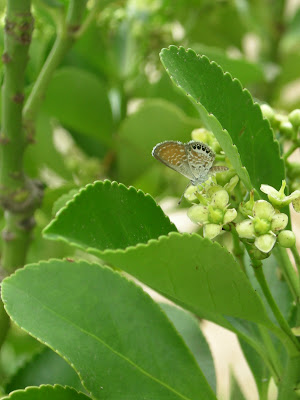
Western Pygmy-Blue (Brephidium exile), North America's smallest butterfly with a wingspan that may not even reach half an inch.

Reakirt's Blue (Echinargus isola)

Texan Crescent (Anthanassa texana)
We do have a porch light. As Heidi mentioned, there happens to be an active Barn Swallow (Hirundo rustica) nest using it as substrate. So we are going to have to come-up with another plan for attracting moths at least until that nest has fledged.
It is currently in incubation stage.
We've named the swallow Gladys. However, it has been observed that both parents share incubation duties.... how nice. So Gladys is female, and Gladys is male.
This is Gladys...., well, Sir Gladys I suppose:

Also, our first two groups of young Aplomado Falcons (Falco femoralis) arrive this afternoon!

We don't have internet at the house. We have to walk several blocks down slope to pirate wireless from a local business. With that in mind, plus once the falcons arrive we'll be going full-throttle, we aren't yet sure how regular our blog updates will become.
We will all just have to see.
At the moment it is partly cloudy, and the wildlife is happy. Particularly at a shrub in the front yard. SO many wasp species, a few net-winged beetles, and some familiar butterflies.
One of my favorite members of the wasp order, Hymenoptera, is the Cicada Killer (Sphecius spp):
These are huge 2+ inches long insects. When one hears within the monotony of the "whining cicadas" summer-long buzz a cicada quickly and individually deviate its contribution, likely it's due to an attack from Sphecius species.
One particularly interesting wasp family is Scoliidae. They are largish, hairy insects that are parasitic to larvae of scarab beetles.
Females dig around to uncover scarab larvae, lay an egg on it, and peace on out of there.
So many other wasp species on that particular shrub, so little time.
A few butterflies found their way on to it, all of which are very familiar:
Western Pygmy-Blue (Brephidium exile), North America's smallest butterfly with a wingspan that may not even reach half an inch.
Reakirt's Blue (Echinargus isola)
Texan Crescent (Anthanassa texana)
We do have a porch light. As Heidi mentioned, there happens to be an active Barn Swallow (Hirundo rustica) nest using it as substrate. So we are going to have to come-up with another plan for attracting moths at least until that nest has fledged.
It is currently in incubation stage.
We've named the swallow Gladys. However, it has been observed that both parents share incubation duties.... how nice. So Gladys is female, and Gladys is male.
This is Gladys...., well, Sir Gladys I suppose:
Also, our first two groups of young Aplomado Falcons (Falco femoralis) arrive this afternoon!
We don't have internet at the house. We have to walk several blocks down slope to pirate wireless from a local business. With that in mind, plus once the falcons arrive we'll be going full-throttle, we aren't yet sure how regular our blog updates will become.
We will all just have to see.
departures and arrivals
7/2 - Goodbye to Waco
Hurricane/Tropical Storm Alex bestowed upon us plentiful rainfall - it amounted to an eight hour car wash for both vehicles! Other than a Little Blue Heron near Evant, a Blue Jay over San Saba, a few Turkey Vultures and Scissor-tailed Flycatchers as we neared Fort Stockton, bird life was quiet. The rain even kept all but a handful of bugs off the windshield! Oh, we did have fly-over Ladder-backed Woodpeckers and a stealth Canyon Towhee and some perched Swainson's Hawks towards I-10.
Upon arrival at our destination, we were greeted by angrily fussing Barn Swallows who are nesting above the porch light. While unpacking we overheard the chatter of a Curve-billed Thrasher, Northern Mockingbird, Ash-throated Flycatcher, seeping of Lesser Goldfinch, warbles of House Finches, White-winged Doves, etc. Great-tailed Grackles were bathing out front and as I checked the view from each window, the bathroom revealed a Bronzed Cowbird out back, a pair of Eurasian Collared-doves out front and an absolutely breathtaking male Vermillion Flycatcher. Evening Common Nighthawks are keeping us pleasantly on alert for their "BEERT" calls.
***
7/3 - Morning at Post Park
After a wonderfully sound night of tranquility* we headed to Post Park, just south of Marathon, for a bit of early morning investigation.
* there were firecrackers, rockets, sparklers, loud explosions, kids screaming, people yelling, dogs barking and all of the other 2nd of July noises until it started raining around 11 pm.
The park itself is a small bit of land with a swath of riparian heaven running through it. Of the 28 species gleaned from the park itself, the birds most abundantly represented were flycatchers:
Vermillion Flycatcher
Ash-throated Flycatcher
Black Phoebe
Say's Phoebe
Cassin's Kingbird
Western Kingbird
We also saw an active Lesser Goldfinch nest, a fledgie Canyon Towhee following and begging from its biological parent, a begging baby cowbird (fed by female Orchard Oriole), food carry by many species, nesting material carry by Summer Tanagers, "Timmy" the resident American Coot, and so much green that it felt like Abilene in March. Considering that we had a nicely wet winter and spring, these summer rains will likely push plants into a late summer bloom that will allow insects as well as birds to thrive for the rest of the summer. (Our porch swallows seem to be working on their second attempt of the year - it wouldn't surprise me if they manage a third if this weather keeps up!)
Anyway, this weather is so fantastic that the road we now live on is a giant puddle! Kind of unexpected for the desert ;-) The porch Barn Swallows, Gladys & Mr. Gladys, still aren't used to our coming and going, so we've minimized porch-sitting until such time as they're more comfortable. The yard Vermillion Flycatcher pair is now affectionately known as the O'Haras. The two Bronzed Cowbirds most commonly seen from the bathroom window are currently unnamed, but the nesting House Sparrows are dangerously close to being dubbed "The Octo Family" due to their high rate of procreation.
01 July 2010
"Hey Now,..."
"... all you sinners. Put your lights on. Put your lights on." - Carlos Santana
I tend to leave the porch light on in the evenings. Then check the lights and the adjacent patio walls for cool insects, more specifically for the want of interesting moths, before heading to bed.
Often rain systems and leading edges of hurricane-influenced meteorological events can be the facilitator of interesting and less than common moths.
Last night, several interesting insects, but nothing too out of the ordinary...yet.
However, sphinx moth (Family Sphigidae) species are always attention-getting due to size, patterns, behavior, and other characteristics.

Waved Sphinx moth (Ceratomia undulosa)
C. undulosa is "common east of the Rockies, its larvae feeding on ash and other members of the olive family." (Eaton, R. and Kaufman K., Field Guide to Insects of North America, pg. 242, 2007)
We certainly have ash trees on the property and around this neighborhood.

My father had actually reported a Northern Mockingbird (Mimus polyglottos) eating a large moth outside the dining room window back on 27 April 2009. Upon hearing that, Heidi and I searched for and found the moth's wings the following day.
'Twas a Waved Sphinx, or so we believed.
However, the photos we took of the faded, wet wings weren't conclusive enough for one of the few state record keepers. That's understandable, there are a few other species that theoretically could have once sported those faded dilapidated wings.
McLennan County, Texas is in the range of this species. However, in the world of Lepidoptera, scores of species are under-reported. Not too many folks in the greater-Waco, TX area looking for and kicking up moths and butterflies, I suppose.
These photos ought to do.

Tomorrow morning we are heading out to the trans-Pecos region of far-west Texas. This portion of the Chihuahuan Desert is were I worked, completed grad school requirements, and otherwise lived for ~ 4 years or so.
I was not the avid amateur moth and butterfly hunter back then as I am now. I spent much of my time working on Montezuma Quail (Cyrtonyx montezumae) and kicking rocks in the Davis Mountains.
I look forward to returning with a watchful eye toward leps. It brings a newness to a region I otherwise know.
Hopefully we'll have a porch light.
I tend to leave the porch light on in the evenings. Then check the lights and the adjacent patio walls for cool insects, more specifically for the want of interesting moths, before heading to bed.
Often rain systems and leading edges of hurricane-influenced meteorological events can be the facilitator of interesting and less than common moths.
Last night, several interesting insects, but nothing too out of the ordinary...yet.
However, sphinx moth (Family Sphigidae) species are always attention-getting due to size, patterns, behavior, and other characteristics.
Waved Sphinx moth (Ceratomia undulosa)
C. undulosa is "common east of the Rockies, its larvae feeding on ash and other members of the olive family." (Eaton, R. and Kaufman K., Field Guide to Insects of North America, pg. 242, 2007)
We certainly have ash trees on the property and around this neighborhood.
My father had actually reported a Northern Mockingbird (Mimus polyglottos) eating a large moth outside the dining room window back on 27 April 2009. Upon hearing that, Heidi and I searched for and found the moth's wings the following day.
'Twas a Waved Sphinx, or so we believed.
However, the photos we took of the faded, wet wings weren't conclusive enough for one of the few state record keepers. That's understandable, there are a few other species that theoretically could have once sported those faded dilapidated wings.
McLennan County, Texas is in the range of this species. However, in the world of Lepidoptera, scores of species are under-reported. Not too many folks in the greater-Waco, TX area looking for and kicking up moths and butterflies, I suppose.
These photos ought to do.
Tomorrow morning we are heading out to the trans-Pecos region of far-west Texas. This portion of the Chihuahuan Desert is were I worked, completed grad school requirements, and otherwise lived for ~ 4 years or so.
I was not the avid amateur moth and butterfly hunter back then as I am now. I spent much of my time working on Montezuma Quail (Cyrtonyx montezumae) and kicking rocks in the Davis Mountains.
I look forward to returning with a watchful eye toward leps. It brings a newness to a region I otherwise know.
Hopefully we'll have a porch light.
28 June 2010
Bird-Safe Buildings & bis spaeter
I've just added a fantastic link to our "the links we can link" section of the sidebar - Bird-Safe Buildings by Project BirdSafe of MN Audubon.
There's a pdf on the site that is absolutely fantastic and I'd love to see it incorporated in references for architecture, urban planning, landscape design, biology, etc. It is relevant to all of the above. Maybe even astronomy, due to the light pollution factors!
To download the pdf, click here. It's the best 3.7 MB you'll download this year.
As for the 'bis spaeter' portion of the title - on Friday, we are heading out towards Fort Stockton, where we'll be for the next three months. Here's a little snippet of what we'll be involved in - Aplomado Falcon Update via The Peregrine Fund. Hopefully we'll be able to update the blog on occasion, but if not, the abundance of posts this month will hopefully make up for it!
25 June 2010
the return
As we pack up to leave for west Texas again, here's the last batch of photos from a month ago:

The horizon looks benign until you notice a creeping plague of wind farms...

These areas are poorly studied for overall impact - what we do know about migration would suggest that these dry areas really aren't bird-dense. That does not stop local and migrating birds from being killed, though. We don't really even understand anything about bat migration at this point, so pushing wind farm development without knowing the basic life histories of the critters impacted is a very ill planned scheme. For all of the screaming for "green" energy, very few people are willing to unplug their own habits.

Matt and I added another pile of counties to our ever-growing county courthouse list. Texas has something like 257 counties and we are trying to visit every single one* (except for those in major urban centers, because those are no fun). Upton County's courthouse matched the earth and the sky, and was perched atop a lovely hill.

The design of the building didn't interest Matt too much, though we did have a good chuckle over the cactus growing on the awning over the front door! What struck me about this building is the use of bright colors. They appear to be opaque panels, but window film can certainly be modified in a manner that would make a glass box look identical to this building; it might be a bit extreme to print faux bricks on the film, but you can minimize the reflective surfaces and space them out in ways that would be less susceptible to bird strikes.

For the nephew: there are a ton of "Oliver's" signs in San Saba, TX - and they're not just into pecans! Quite a few signs are for pecan related things though, so we snuck a picture before returning to Waco.
The horizon looks benign until you notice a creeping plague of wind farms...
These areas are poorly studied for overall impact - what we do know about migration would suggest that these dry areas really aren't bird-dense. That does not stop local and migrating birds from being killed, though. We don't really even understand anything about bat migration at this point, so pushing wind farm development without knowing the basic life histories of the critters impacted is a very ill planned scheme. For all of the screaming for "green" energy, very few people are willing to unplug their own habits.
Matt and I added another pile of counties to our ever-growing county courthouse list. Texas has something like 257 counties and we are trying to visit every single one* (except for those in major urban centers, because those are no fun). Upton County's courthouse matched the earth and the sky, and was perched atop a lovely hill.
The design of the building didn't interest Matt too much, though we did have a good chuckle over the cactus growing on the awning over the front door! What struck me about this building is the use of bright colors. They appear to be opaque panels, but window film can certainly be modified in a manner that would make a glass box look identical to this building; it might be a bit extreme to print faux bricks on the film, but you can minimize the reflective surfaces and space them out in ways that would be less susceptible to bird strikes.
For the nephew: there are a ton of "Oliver's" signs in San Saba, TX - and they're not just into pecans! Quite a few signs are for pecan related things though, so we snuck a picture before returning to Waco.
24 June 2010
Shirt skirt - original
These photos were piled up from June 2010, but there was no post! Trying to reference this design (which now exists in a longer, swirly teal color as well) was hard without pictures, so here goes a backdated post:
Ingredients -
1 shirt that isn't too tight for your bum
1 drawstring

Step one:
Cut off sleeves

Step 2:
Chop neckline on front and back

Step 3:
Cut sleeve seam
Step 4:
Turn skirt sideways and fit sleeve
cuttings into skirt gap (they will be
upside down from their original
configuration!)
Step 5:
Add drawstring
Final product: shittacular photo of shirt skirt.

Subscribe to:
Posts (Atom)




 Posts