05 March 2011

Child's play

My thoughts about wind farms can be found in other blog posts.


This set of [wind] farm-related toys was found at our local Alco store in Alpine; it makes industrial scale wind turbines seems benign. One behemoth wind turbine (perhaps 1 MW, no more than 1.5 MW from the looks of it) powers a farm and it's peachy. I mean, there's a tractor and a greenhouse and some plants, too! But building one wind turbine by itself isn't practical, efficient, or realistic. So the smallest cluster tends to be ~6 and those are generally within easy driving distance of another cluster... otherwise you've got technicians who would have to drive all day to get between isolated turbines. But I digress.


Really, the biggest problem I see is that this set is incomplete. The turbine foundation is forgivable - nobody really cares about a few trucks of concrete underground - but the power lines? How about the substation? There needs to be at least one replacement blade. Clearly dead birds and bats are left to the imagination (along with the techs and out-of-state operators, not to mention international corporations who sponsored it unless it's actually backed by a multi-millionaire farmer). Child's play.

Again, I digress. But that box gave me chills. "Country Life" indeed - because nobody wants a wind farm in their suburban backyard. Oof.

27 February 2011

Crafty

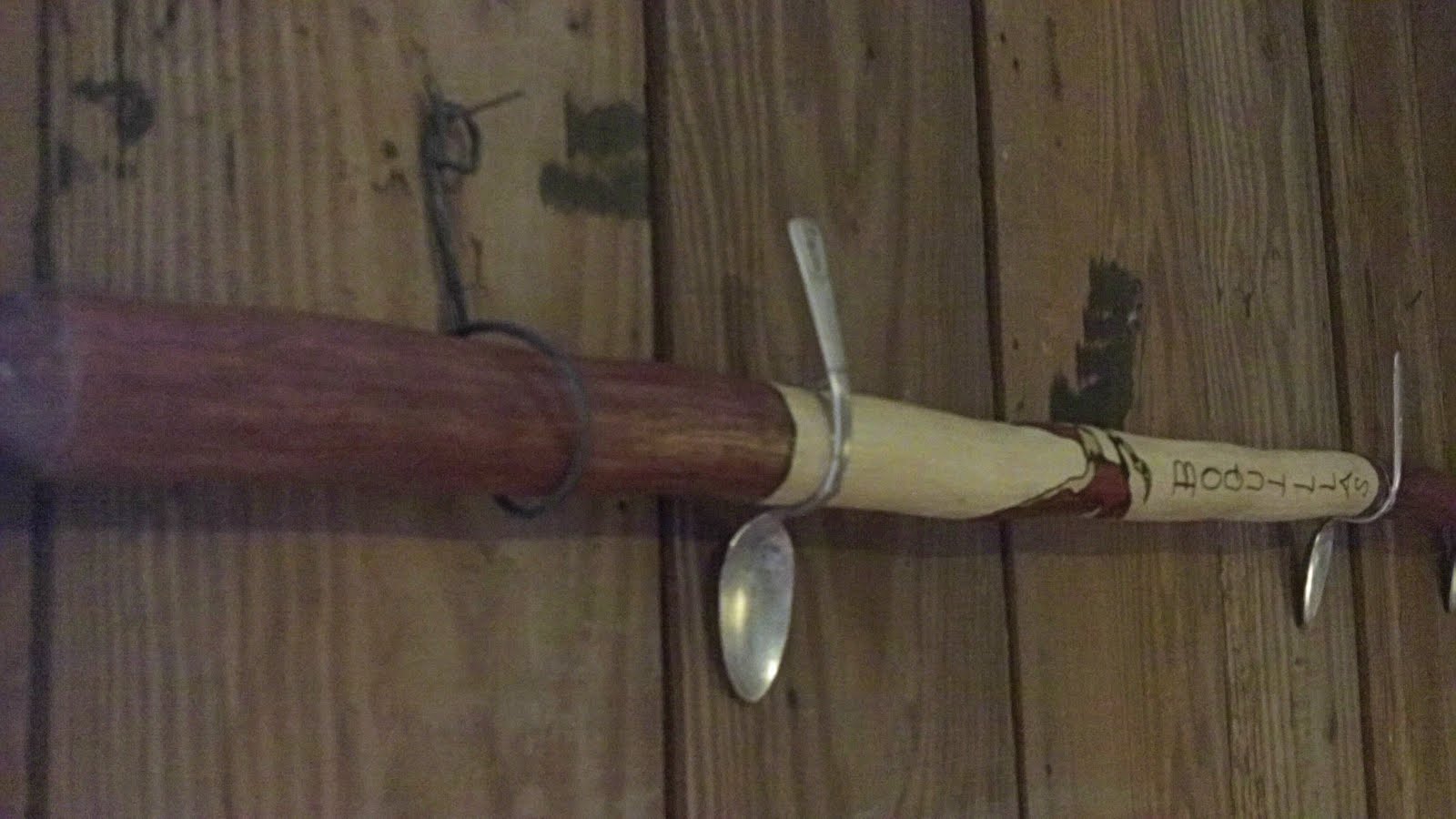
I'm a bit late in posting this stuff, but better late than never, right? Until our first signs of spring, I busied myself with a few projects that had been festering in the back of my mind. Spoons as a hat rack, for one. And bottle caps as a shoe scraper, for two.

Ingredients for Spoony Hat Rack-Stick:
Four spoons (recycled)
Walking stick (collecting dust in a corner)
Thick wire (recycled)
Thin wire (from a necklace re-stringing project)
Two nails (new)

Apologies for the poor quality photo and strange angle; use your imagination!


...voila, four spoons and a walking stick from Boquillas Mexico (available for purchase at the gift shops in Big Bend National Park) turned into a hat rack. And no spoons were permanently damaged; this entire thing can be disassembled with only loss of wire!

Another lovely project that still needs some hammering: foot-shaped shoe-scraper! Dozens of bottle caps were saved by friends and coworkers, but there still weren't quite enough for the initial design.

Ingredients for Bottle Cap Shoe Scraper:
Tacks (new)
Bottle caps (recycled)
Scrap wood


Not too bad, eh? Puppy helped.


Unfortunately, many bottle caps were injured during the construction of this piece. It's also unlikely that the wood or tacks will recover from the experiment.

15 February 2011

Upcoming local things...

If you don't read our Big Bend regional blog, here's what you're missing:

Please note that dates/times may change but we will do our best to post accurate and updated information as soon as we know!

Friday Night [Black]Lights

On Friday nights starting in March, the Marathon Motel invites all interested to join in blacklighting for moths around the property. This is a new region for us, with diverse bugs and promising prospects - amateurs to experts are very much encouraged to join and share your knowledge and enthusiasm! We may, on occasion, blacklight at Post Park as well - those dates TBA.


Sunday Breakfast & Birds

Join us on Sunday mornings starting in March at the Marathon Coffee Shop* for the best breakfast burritos in town! We will leave for Post Park/Fort Pena Colorado at 8 and for those wishing to meet at the park directly, meet at 8:15 for a free guided bird/butterfly walk. After Post Park, folks are invited to Guzzi Pizza for species list review, regional wildlife discussion and some of the best pizza and 'sandwiches' in West Texas!

* The sign by the road says "Breakfast and Lunch" - it's on the far west end of town, just past the Gage Hotel; they open at 7 AM and do not accept checks or debit/credit cards, so remember to bring cash!

11 February 2011

Cold without redemption

"Actually not at all sad, if you think about it! It's the other 987,208,947 carcasses you have collected that were sad." - Froggi

Ok, our winter has been remarkably mild, except for every other week or so when we get a cold front that lasts anywhere from 4-20 hrs. The frigid blast last week left us without water from Monday night until Saturday afternoon - and we'd even left the faucets running. Thankfully we only found one pipe broken, it was the main well line at a spot above ground. That's what happens when three days are below freezing with gusty winds.

Enough of our inconveniences.

I've posted before about birds hitting windows, cars hitting birds, wind turbine blades hitting birds, and a myriad of other bird death issues. However, I think this will be my first post to actually document a bird that died of natural causes. It is an Inca Dove. Adult, from what I can tell. Not sure of sex.


I wish I'd gotten a photo of it where I found it. But the temps were getting warmer and I wanted it to be preserved ASAP. It was in the yard, under the tall evergreen thing that our clothes line passes - where nothing can be hung on the line for a few feet because Inca Doves roost there and their droppings are magnetically attracted to clean clothes.

To recount all of the dead birds I've found, photographed, 'salvaged' or otherwise witnessed, the list would be well over one hundred species long. Baby Tree Swallows thrown out of their nest by House Sparrows. Natural cause? Hardly. Certainly, I've seen dead fledgelings and nestlings and those are definitely natural causes. Dead baby bird, still in the nest, tangled in yarn/string/twine/fishing line that cut off its circulation? Also not a natural cause.

Gulls, terns, pelicans. Perhaps some were natural. Most were beyond the point of determining cause - they could have ingested hooks or plastic. Indeed, even the one domestic bird that I watched die of West Nile... it was quick. Yet this Inca Dove is part of a species close to my heart, and one of our eight regulars in the yard. Life is fragile, but resilient. Yet there's such a fine line life walks.

20 January 2011

seasonal variations

December 25th was a fun day for Anakin; it would have been our annual card if those [expletive deleted] park ducks hadn't been in the photo. Sigh. Anyway, the pup enjoyed the crisp weather - it's good for playing fetch and chewing on sticks. Regal looking fellow, isn't he?


January 11th, Marathon was ridiculously cold. Barely any frost on the car windows though, so there was little excitement in town. Driving into Alpine, however, was a completely different story! When you drive west from Marathon along Hwy 90, the road bends to the north at "Altuda Pass" (Altuda at least being the local name for the mountain at the bend) and apparently that's as far as the frozen fog had gotten. Everything beyond the bend towards Alpine was frosted, foggy and white. On the way back to Marathon I snapped this photo (and you can see the slope behind the tree, rising up toward Altuda itself).


On the 19th, it was a balmy closer-to-80 along the Rio Grande, so we took advantage of a Loggerhead Shrike being called a Northern to go investigate. This is the overlook trail at Daniel's Ranch, above Crissal Thrashers and where the Tufted Flycatcher used to hang out.


Of course, today's high was 45 and the wind was a steady 20 mph with gusts over 30 all morning... And for a warmer mental image, here's some prickly pear variety the Lost Mine Trail while the weather was cooperative:


...so the question: is it a purple prickly pear? Or is it a green prickly pear? Or are they two (or three, or four) plants growing close together with complete disregard to their pigmentation? Any prickly experts out there care to comment??

18 January 2011

January's Public Service Announcement

Admittedly, this PSA would have been fresh off the press in 2007, but the message is timeless. Similar to our water conservation PSA, it's brilliantly inspirational. Since we no longer live in a place with water in the toilet, our water conservation has been pretty easy; our next goal is to balance out our use of plastic bags (we've got canvas bags and used them obsessively in Waco, but here we get them because they double as trash bags...)


Another version of the song with introduction can be found here.

Those of you not familiar with Tim Minchin may think of him as, perhaps, the Weird Al of Australia, but with his own music and heavy eye makeup most of the time.

15 January 2011

awkward names and spying vultures

You knew the day would come: someone would name a Bald Eagle "wowie-cakes" ...I kid you not. Of course, it was meant to be pronounced wo-whee-jah-kah, but that clearly wasn't going to happen! So it has been renamed Celilo (suh-LEYE'-loh); so it went from being "that which is real" to an "Indian fishing village on the Columbia River that was submerged by the construction of The Dalles Dam." That's an improvement? Wowiecakes works just fine for me.

As for spying vultures, I posted a little something about avian Israeli espionage over at ifoundabandedbird.blogspot.com - and here's the video from it:

The Colbert ReportMon - Thurs 11:30pm / 10:30c
Israeli Vulture Spy
www.colbertnation.com
Colbert Report Full EpisodesPolitical Humor & Satire BlogVideo Archive

30 December 2010

Resist Temptation

Gentle reminder, dear birders.

National Parks are no 'pishing' zones.
They are also no 'playback' zones.

This applies to State Parks, National Wildlife Refuges, Wildlife Management Areas, areas that are birded, ANY area that has endangered species, and at any time of year that birds could be nesting. It's in the better interest of the bird to avoid undue stress, activity, etc.

While iThings and eGadgets and crazyphones might be required for surviving the urban jungle, avoid temptation. Leave the devices off, or in your car while out birding. Use headphones if you want to double check a call you've heard. Don't know what you saw? Wait, look harder, or walk away. Don't know what you heard? Look for the source; not all recordings will cover all vocalizations.

***

This topic came up due to recent discussions at a CBC, and it highlights the technology gap that many birders have never experienced. Birders who have never birded without the technological crutch would have a very different experience without it. I have never used playback; Matt and I never even carry equipment capable of it. We go through a mental checklist of whether or not it's worth it for the bird and situation before 'pishing' - birds may go unseen, but it's better for the bird. The welfare of the creature is of utmost importance, our sighting/documentation is not even on the radar. For CBCs, in some situations, it may be worth it 'for the count' to get a better look at a bird. Still, all of the above checks and balances apply.

Learn calls. Leave the gear at home.

Our backgrounds are in conservation; perhaps this makes us more aware, but perhaps it also shows that bird-ing does not give birds the respect that is due.