Curlews on the move is a post that is now up over at I Found a Banded Bird, feel free to check it out and admire the science behind tracking Long-Billed Curlews (Numenius americanus).
Inspired by the Nebraska Long-billed Curlew Tracking Project.
18 June 2010

after the storm
The motel in Study Butte had Cactus Wrens singing on territory, desert cottontail bunnies all over the place, plenty of Western Kingbirds, ravens and other creatures around...

Easter Egg Valley/Chisos Mining Co. Motel - fuzzy proof that Chair feels just as comfortable in the country as in the city. For other adventures with Chair, check out LovelyListing.com. It's a blog beyond words.

Our night baiting left only one tiny moth. Our afternoon attempts were foiled because the bait was left outside the room and cleared away before we got back. Heh, I'd hate to think what they thought it was. [see our bait post]

"Squail" = Scaled Quail (Callipepla squamata), a common sight/sound.

As best I can tell, this sad little squished friend is a Ten-lined June Beetle (Species decemlineata) of some sort - a remarkably huge bug. I'd love to work with a live one, since the flatness is a bit deceiving.
Also from the front porch, not only a foraging Cactus Wren, a Greater Roadrunner being followed by a very uncoordinated fledgling! The adult mostly ignored us and poked around for bugs, the young stayed a few feet behind, constantly making beggy noises while quivering the wings while hunched down. The adult at one point turned to face it and made a rattling beak clack that was reminiscent of wooden noise making toy. This parade of life along the porch came within 5 feet of us! And of course, my camera was inside the room at the time. Ah, life.
For a photo of a stumpy young roadrunner, check out this sad post over at The Fat Finch.
Easter Egg Valley/Chisos Mining Co. Motel - fuzzy proof that Chair feels just as comfortable in the country as in the city. For other adventures with Chair, check out LovelyListing.com. It's a blog beyond words.
Our night baiting left only one tiny moth. Our afternoon attempts were foiled because the bait was left outside the room and cleared away before we got back. Heh, I'd hate to think what they thought it was. [see our bait post]
"Squail" = Scaled Quail (Callipepla squamata), a common sight/sound.
As best I can tell, this sad little squished friend is a Ten-lined June Beetle (Species decemlineata) of some sort - a remarkably huge bug. I'd love to work with a live one, since the flatness is a bit deceiving.
Also from the front porch, not only a foraging Cactus Wren, a Greater Roadrunner being followed by a very uncoordinated fledgling! The adult mostly ignored us and poked around for bugs, the young stayed a few feet behind, constantly making beggy noises while quivering the wings while hunched down. The adult at one point turned to face it and made a rattling beak clack that was reminiscent of wooden noise making toy. This parade of life along the porch came within 5 feet of us! And of course, my camera was inside the room at the time. Ah, life.
For a photo of a stumpy young roadrunner, check out this sad post over at The Fat Finch.
17 June 2010
oh, hail, no!
Since this post was written, the damage has been repaired. But we'll leave it to your imagination - hailstones the size of grapefruits and baseballs, thunking on the roof of the truck. And little quarter-sized ones bouncing off the hood.


This was on the drive from Alpine to Study Butte. We were too far from civilization to find shelter, so we turned into a drive and angled the truck to keep the windshield from getting too many direct hits. Shards of hail littered the ground everything white in the photos above = ice chunks.

Leaving Alpine - the topography of the area is fantastic, regardless of low light due to epic storm. So in the ~60 mph gusts, we tried to skirt south of the storm.


We wound our way down to Study Butte with little more to note, other than a lot of folks who had stopped on their way north to wait for the storm to die down. Smart people. It was a beautiful lightning show.
One stop on the way down was in the Christmas Mountains, where one our of birding gave way to distant clouds and the ominous darkness that urged us to continue to our evening destination.
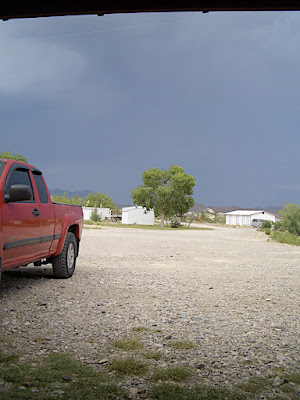
Upon arrival, the sky to the north was dark, but we could see the mountains. Wind was gradually picking up and the view from the motel porch was perfect for weather watching. In the photo above, between the large cottonwood tree and the white building to its right - look for the 2 large white yucca blossoms that are blowing straight sideways. Windy.
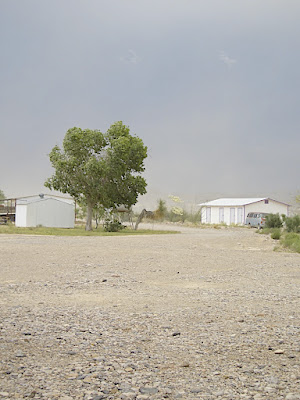
When the dust clouds rolled in, they blotted out the mountains and made visibility shrink to less than 1/8 of a mile. While it never did hail on us, it rained mud with a strength usually reserved for tropical depressions!
Texas weather is ridiculously awesome.
This was on the drive from Alpine to Study Butte. We were too far from civilization to find shelter, so we turned into a drive and angled the truck to keep the windshield from getting too many direct hits. Shards of hail littered the ground everything white in the photos above = ice chunks.
Leaving Alpine - the topography of the area is fantastic, regardless of low light due to epic storm. So in the ~60 mph gusts, we tried to skirt south of the storm.
We wound our way down to Study Butte with little more to note, other than a lot of folks who had stopped on their way north to wait for the storm to die down. Smart people. It was a beautiful lightning show.
One stop on the way down was in the Christmas Mountains, where one our of birding gave way to distant clouds and the ominous darkness that urged us to continue to our evening destination.
Upon arrival, the sky to the north was dark, but we could see the mountains. Wind was gradually picking up and the view from the motel porch was perfect for weather watching. In the photo above, between the large cottonwood tree and the white building to its right - look for the 2 large white yucca blossoms that are blowing straight sideways. Windy.
When the dust clouds rolled in, they blotted out the mountains and made visibility shrink to less than 1/8 of a mile. While it never did hail on us, it rained mud with a strength usually reserved for tropical depressions!
Texas weather is ridiculously awesome.
16 June 2010
inexcuseable - the impact of cleanup
...if there's a transcript for this, I'd love to get it. But it's worth watching, absorbing, and thinking about. The Gulf, My Gulf, the bounty that turned me into a birder - is not only being thoughtlessly run over by vacationers - it is being swamped with massive equipment as part of the cleanup. So the little birds that don't stand a chance against ATVs are now also subject to being smashed by giant trucks.
Edit: we now have an "oil spill" tag
walls of Alpine
Alpine has a fantastic mural that I snuck a few photos of -


The town has a lot of history and the mural beautifully allows snippets of the past to be displayed. Across the street and a few blocks down was another wall that caught my eye:

For such a scalding area, the shade must be a relief for the building! I think green walls are a fantastic idea... of course, after it chokes out the light and covers the doors, it probably isn't the greatest option for extended periods of neglect. But a bit of judicious trimming would certainly benefit everyone.
The town has a lot of history and the mural beautifully allows snippets of the past to be displayed. Across the street and a few blocks down was another wall that caught my eye:
For such a scalding area, the shade must be a relief for the building! I think green walls are a fantastic idea... of course, after it chokes out the light and covers the doors, it probably isn't the greatest option for extended periods of neglect. But a bit of judicious trimming would certainly benefit everyone.
15 June 2010
down from the mountains, into the cactus
Since I managed to get the two previous posts up without these two photos; these are from the Davis Mountains - a Drusius Cloudywing (Thorybes drusius) and your intrepid explorers.

Alas, there's a bit of blur due to digi-bin tactics; it was not cooperative though, so blurry is far better than nothing at all!

After we made our way out of the mountains, we headed to the Sul Ross campus to look at all of the cacti in bloom. Collectively, I think succulents are among my favorite plant/flower beings. There is a bit of personality to each plant, yes, but there's something about them that speaks louder than their spines (in the case of cacti, anyway).


Yucca (also called Spanish Dagger) has been a friend of mine since I discovered that the flower petals taste like cabbage. Ocotillo is still a fairly new acquaintance - its wispy frame is generally no so full of bright leaves and blossoms; like many desert plants, it puts on a show after rain but will drop leaves to conserve moisture later in the dry season.


Cholla (L) is known for being vicious. As with everything else, don't get near it unless you're fully prepared to deal with the consequences. Prickly Pear (R and below) are more mild tempered, if we dare to suggest it.

Lovely cacti, are they not?
Alas, there's a bit of blur due to digi-bin tactics; it was not cooperative though, so blurry is far better than nothing at all!
After we made our way out of the mountains, we headed to the Sul Ross campus to look at all of the cacti in bloom. Collectively, I think succulents are among my favorite plant/flower beings. There is a bit of personality to each plant, yes, but there's something about them that speaks louder than their spines (in the case of cacti, anyway).
Yucca (also called Spanish Dagger) has been a friend of mine since I discovered that the flower petals taste like cabbage. Ocotillo is still a fairly new acquaintance - its wispy frame is generally no so full of bright leaves and blossoms; like many desert plants, it puts on a show after rain but will drop leaves to conserve moisture later in the dry season.
Cholla (L) is known for being vicious. As with everything else, don't get near it unless you're fully prepared to deal with the consequences. Prickly Pear (R and below) are more mild tempered, if we dare to suggest it.
Lovely cacti, are they not?
14 June 2010
Common Sootywing (Pholisora catullus)
As the title implies, Common Sootywing (Pholisora catullus) - a cooperative individual in the Davis Mountains. This is the same individual as was featured in Matt's post, photos from the field.


And the first few shots that Matt took were documented:

A few more thumbs (different than the original post, but similar):


And the first few shots that Matt took were documented:
A few more thumbs (different than the original post, but similar):
13 June 2010
big land, small inhabitants
A few pretty pictures to pass the time:

Flowers at Fort Davis - what a wonderful spring and summer for wildflowers!

The paper-thin seed pods, no idea what the plant was.

...and ladybug larvae on a bluebonnet sprig!
Flowers at Fort Davis - what a wonderful spring and summer for wildflowers!
The paper-thin seed pods, no idea what the plant was.
...and ladybug larvae on a bluebonnet sprig!
Subscribe to:
Posts (Atom)




 Posts
Posts